If hot water in a Priddis home smells unusual or carries deposits, establish whether the problem starts in the supply, treatment system or heater before replacing the tank. Compare cold and hot water at several fixtures and identify the actual supplier. Confirm the parcel is within Foothills County and arrange plumbing, gas or electrical work with appropriately qualified trades.
- Hot-only odour points toward the heater but does not identify a single cause.
- Water testing should answer the observed problem rather than assume every acreage has the same chemistry.
- Do not remove an anode as a universal cure for odour.
- Priddis and Priddis Greens require separate water-service verification.
01 /What observations help locate the problem?
Compare cold water and hot water separately at more than one fixture. Note whether the smell appears after a period without use, persists during flow or occurs only at one sink. A drain odour can be mistaken for water odour; a professional can help distinguish them without unsafe exposure. Also record discolouration, particles, reduced flow and any recent treatment maintenance. If both hot and cold supplies change, replacing the heater may leave the cause untouched. A water-quality concern needs advice from the provider or appropriate testing service, not simply a new cylinder.
02 /Why does identifying the supply matter in Priddis?
The hamlet name does not tell you whether a property uses a community supply, private system or well. Foothills County lists Priddis and Priddis Greens separately among its hamlets, and its utility page identifies particular serviced subdivisions. Do not transfer a Priddis Greens service description to every Priddis-area address. Check the water bill, property documents and treatment equipment. For a well, use relevant property-specific results; for a supplied connection, request the provider’s information. Hardness, corrosion behaviour and odour require different questions. An official utility service listing is not a water test for your home.
03 /Could treatment or the anode be involved?
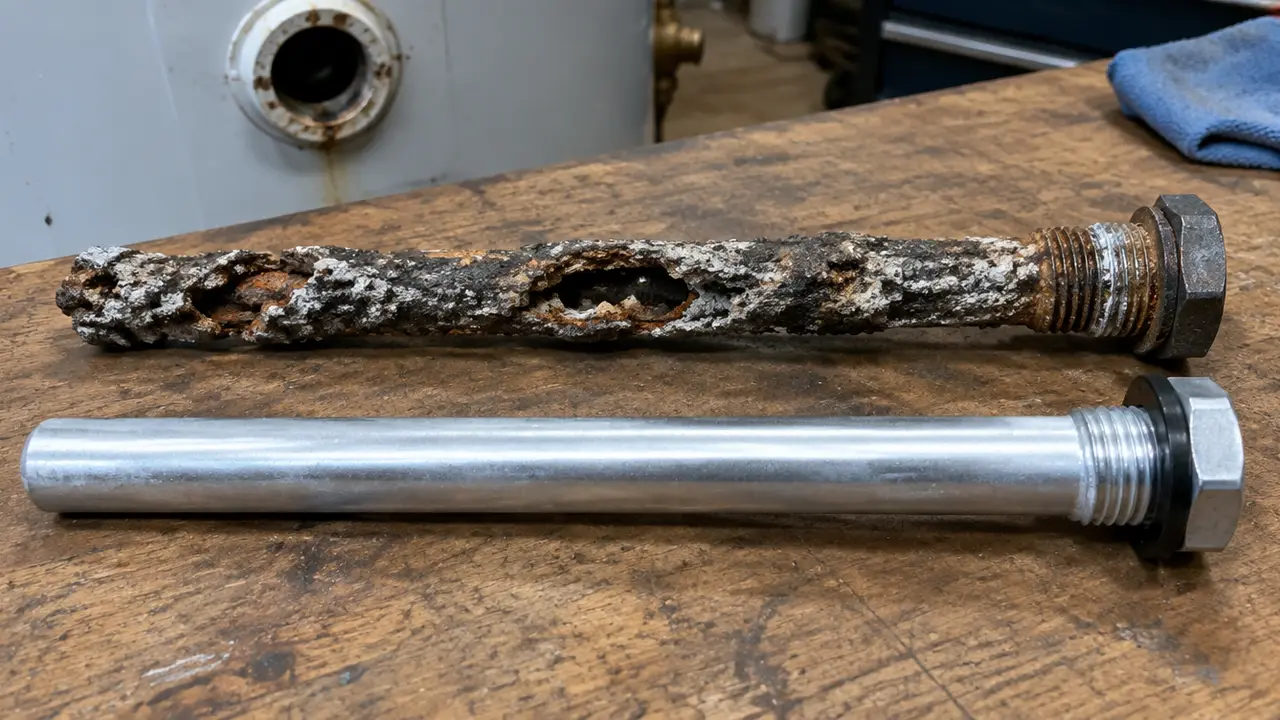
Treatment settings and the tank’s protective anode can influence what happens inside stored hot water. Have a qualified plumber review the heater instructions, anode condition and treatment history together. Removing the anode may sacrifice corrosion protection, and a replacement material should be compatible with the appliance and assessed cause. Descaling, disinfection and temperature adjustments are not interchangeable remedies. They also involve chemical exposure or scald hazards when done incorrectly. The anode guide helps you ask what protects the tank; it does not make an unexplained smell proof of anode failure.
04 /What should the mechanical-room assessment cover?
Show the contractor how cold water reaches the heater through any filters, softener or pressure equipment. Treatment units need access for bypass operation, media servicing and inspection of drain connections. A new tank should not eliminate that access or conceal a shut-off. Ask whether restricted flow originates in treatment equipment, a valve or the heater. Identify a suitable route for any planned flushing and confirm the wastewater destination. A well pressure tank does not automatically provide the thermal-expansion protection needed downstream of devices that close the domestic system.
05 /When is replacement the better decision?
Replacement becomes reasonable when the diagnosis identifies vessel failure, repair is impractical or the equipment cannot meet the household’s requirements. Ask for separate findings and proposed corrections so a water-quality treatment is not confused with a heater replacement. Confirm the civic address and legal parcel with Foothills Building Services for permit and inspection scope. Use a qualified plumber, certified gasfitter for gas work and electrician for relevant electrical changes; never attempt gas work yourself. HAUSE Home is an independent request network. Include observations and test history in a request, and use the tank explorer after the cause is understood.
06 /How can an odour investigation avoid replacing the wrong equipment?
Imagine a home where cold water appears unchanged but an odour is noticed at several hot fixtures after a weekend away. That pattern supports investigating stored hot water, while remaining insufficient to identify a specific cause. Compare it with odour reported only at one sink or present in cold water as well. Give the professional the observations and absence pattern, not a diagnosis borrowed from another property. Where drinking-water safety is in question, contact the provider or testing service. Do not assume a smell’s intensity establishes whether water is safe, and do not introduce household chemicals into the heater.
Treatment history is part of the investigation. Record changes to filter media, softener settings, supply source or maintenance without adjusting equipment to see what happens. A new symptom following a change may be relevant, but timing does not prove cause. The plumber and water specialist may need different information and should clarify who evaluates which part. A heater service does not replace source-water assessment, and a laboratory result does not inspect the tank’s protective components. Ask for a plan that connects findings to the remedy instead of receiving several unrelated recommendations based only on an acreage location.
A proposed anode change should identify the existing part, compatible alternative and expected purpose. Ask whether the manufacturer supports the choice and what ongoing corrosion protection remains. Where powered protection is offered, discuss electrical dependence and service requirements. A broad claim that one material cures every odour is insufficient. Keep the diagnosis and part details with the appliance records so the next technician knows why the modification was made. If the symptom returns, those details are more useful than simply noting that the tank was serviced or that a different anode was installed.
07 /What would a deposit or restricted-flow assessment add?
Visible particles and reduced flow may involve several components. Ask whether the restriction lies in a fixture, treatment unit, valve, heater connection or the vessel itself. If both hot and cold flow are weak, an upstream cause deserves attention. If only one tap is affected, investigate locally before sizing a replacement. Do not assume every mineral deposit requires a softener or every noise proves severe scale. A professional should connect observed symptoms with measurements and inspection. This gives the homeowner a basis for distinguishing useful treatment maintenance from unnecessary replacement of functioning heating equipment.
Chemical cleaning, disinfection and flushing serve different purposes and need separate safety and disposal planning. Ask what procedure is proposed, why it fits the diagnosis and whether the appliance manufacturer permits it. A professional should account for hot water, product instructions, ventilation where relevant and the wastewater route. Do not treat a tankless descaling procedure as instructions for a storage vessel. Nor should a treatment-system drain automatically be used for heater service without checking its design. The proposed work needs to be specific enough that its outcome can be evaluated against the original complaint.
08 /Which repair and replacement comparisons help a Priddis homeowner?
Request one list of confirmed findings and another of remaining uncertainties. A repair option might address an anode or control, while a replacement addresses an unsound vessel; supply treatment may remain necessary under either option. Have the contractor describe those relationships. Ask whether repairs are compatible with the equipment, what condition limits their value and what is included in the follow-up. Comparing the cost of a single part against a complete replacement without understanding the different problems they solve is misleading. A useful proposal makes clear what is expected to change after each option.
If replacement is chosen, retain the water-quality and treatment information rather than assuming it becomes irrelevant. The new appliance may have different maintenance requirements, and the installer should consider actual supply conditions when explaining them. Provide the municipal parcel, water account or private-system records and wastewater arrangement. Foothills service references distinguish particular communities and subdivisions; they do not authorize a universal claim about nearby Priddis properties. Clear address information also prevents an application from being sent to an unrelated town because its name appears on a mailing label or contractor service-area list.
At handover, document the selected model, any anode specification, treatment changes and the maintenance procedure. Ask how to observe the original symptom safely and what would require a new water-quality enquiry. Do not set an arbitrary high temperature in an attempt to solve odour without a coordinated professional plan for safe delivery. A future service provider should be able to see what was investigated and what evidence supported the remedy. That record is the practical value of diagnosing supply, treatment and heater condition separately before the purchase decision.
FAQQuestions people ask
Does a rotten-egg smell prove my well is contaminated?
No. The source needs investigation, including whether the smell is in hot water, cold water or the drain. Seek provider or testing advice about water safety.
Should every Priddis tank have a softener?
No universal recommendation follows from location. Treatment should match measured water characteristics and appliance requirements.
Can I permanently remove the anode?
Do not treat removal as a standard fix. Ask the plumber and manufacturer how corrosion protection will be maintained.
Who answers permit questions for a County parcel?
Foothills Building Services publishes contacts for building, plumbing, gas, septic and electrical queries. Provide the address and exact work description.