Better hot water.
A better plan.
Hot water tank replacement, repair and smarter upgrades in Calgary and the communities around it. Understand the options. Build a useful brief. Request a quote with the details already in place.
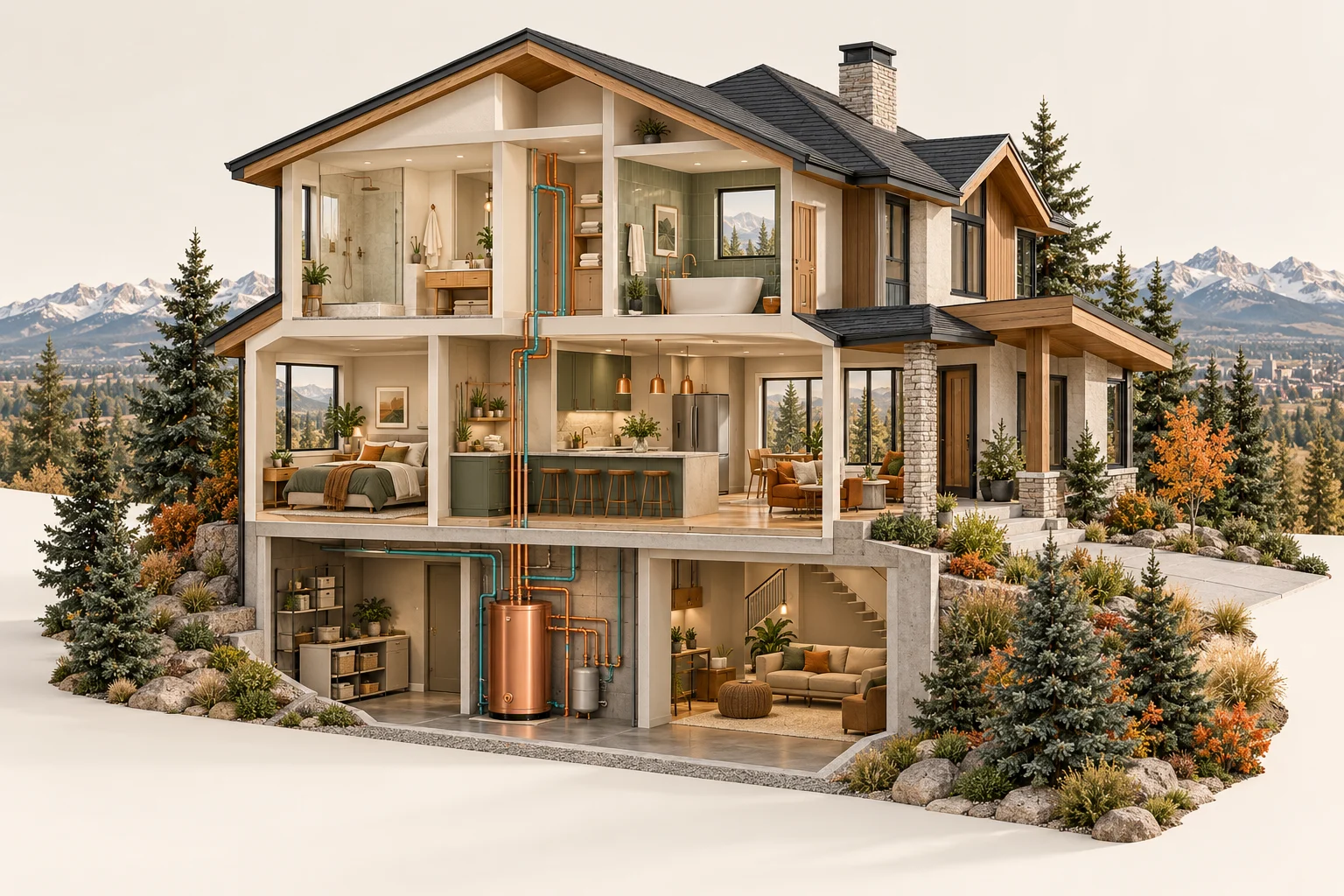
A replacement works best when it fits your busiest hour, your mechanical room and your existing services. Tank size alone cannot tell you that. Start with the problem, compare the whole installation, then have a qualified professional confirm the scope.
See what happens inside a tank ↗Three paths.
One clearer decision.
No hot water today, a tank nearing the end of its life, or a home ready for something different. Each deserves its own plan.
Repair the problem
A cold shower is a symptom. A failed heater, a mixing valve and an overloaded morning need different answers.
Find the likely cause ↗02Replace with confidence
Compare the full installed scope: tank, venting, permits, removal, access and the work around it.
Understand the quote ↗03Rethink the system
Tankless, electric and heat pump options change more than the appliance. Check the space, supply and demand.
Compare your options ↗The tank serves
the whole house.
Who uses hot water at the same time matters more than the number on the tank. Explore a household moment, then use the sizing tool to work through your own numbers.
Two showers. One busy hour.
List the showers, bath and kitchen use that overlap. Compare the heater’s first-hour rating with that demand, rather than automatically buying a larger tank.
Your place.
Your project context.
Individually written local guides. Town permits, county boundaries, acreage water supplies and access all deserve more than a city name on the same page.
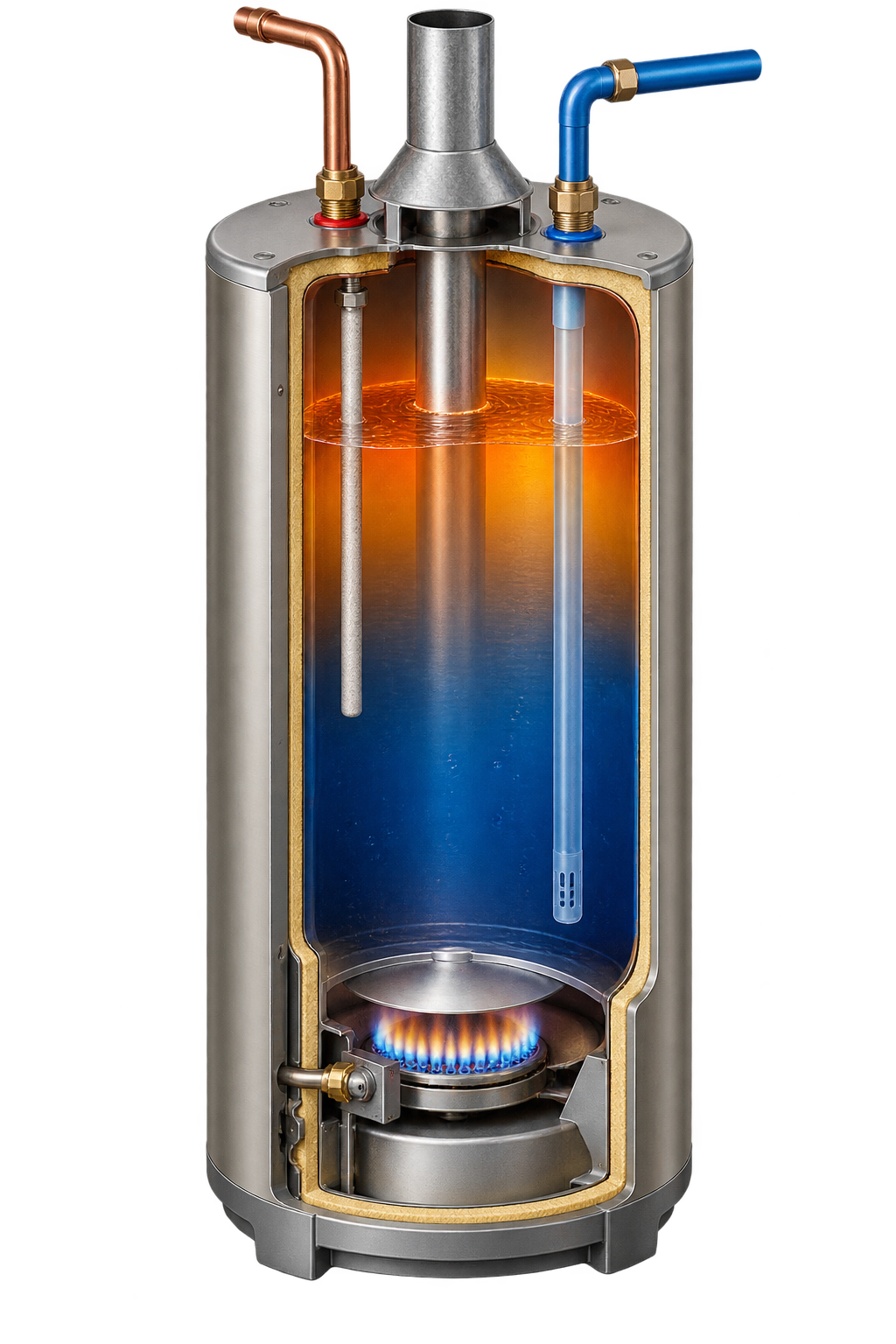
A tank is simple.
The details matter.
The anode protects the tank. The dip tube keeps incoming cold water where it belongs. The vent and safety valve have a job you cannot skip. Understanding these parts makes better conversations with the person doing the work.
Open the Tank Explorer ↗Tools with a purpose.
Work through your household demand, running costs, replacement timing and rental decision. Each tool explains its assumptions.
Hot Water Morning Simulator: play your busiest two hours, minute by minute
Hot Water Morning Simulator: play 6:00 to 8:00 minute by minute and see when a tank or tankless heater runs short, with the full model and worked examples.
↗02 / INTERACTIVERent or Buy Calculator: is renting your hot water tank worth it?
Rent or buy a hot water tank? Compare cumulative rental fees with owning over the tank's life, find the break-even year and check the contract first.
↗03 / INTERACTIVETank Explorer: see inside a hot water tank
Tank Explorer: an interactive hot water tank cutaway with five heater types, an age slider for sediment and anode wear, and 18 parts explained.
↗04 / INTERACTIVETank Lifespan Predictor: plan your water heater's replacement
Tank Lifespan Predictor: enter your water heater type, age, water hardness, flushing and anode history for a planning band, remaining years and a checklist.
↗05 / INTERACTIVEEnergy Cost Comparer: what each water heater costs to run
Compare yearly water heater running costs at your own gas and electricity prices: gas tank, power vent, condensing, tankless, electric and heat pump.
↗06 / INTERACTIVEWater Heater Size Calculator: size a tank or a tankless unit
Water heater size calculator for Canada: estimate peak-hour demand, match it to a tank's first-hour rating, and size a tankless unit's flow and gas input.
↗07 / INTERACTIVEWater Heater Troubleshooter: find the likely cause
Water heater troubleshooter: pick a symptom and fuel type to see likely causes ranked, safe checks you can do yourself, and the signs to stop and call.
↗The complete
hot water field guide.
All the original national guidance is here: illustrated explanations, practical comparisons, safety, maintenance, rental contracts and cost planning.
My hot water tank is leaking
Top, bottom or relief valve
No hot water, or it runs out fast
Water Heater Troubleshooter
What will a replacement cost?
2026 planning ranges
What size tank do I need?
Size Calculator
Tank, tankless or heat pump?
Every type compared
Should I keep renting my tank?
Rent or Buy Calculator
The fundamentals, in one place
How does a hot water tank work?
A hot water tank is a pressure vessel with a heater attached. Cold water from your supply enters at the top, but a plastic dip tube carries it to the bottom so it does not mix with the hot water waiting at the outlet. Heat is added from below by a gas burner, from inside by electric elements, or from the surrounding air by a heat pump. Hot water rises and settles in layers, so the top of the tank is the hottest, and that is where the hot outlet draws from.
Three parts keep it safe and alive. The T&P valve releases water if temperature or pressure climbs too high. An expansion tank absorbs the extra volume of heated water where the plumbing is closed. The anode rod corrodes on purpose so the steel tank does not. When the anode is gone, the tank starts to rust, and a leak is only a matter of time. The how it works guide explains every part, and the Tank Explorer lets you click through them.
Which type of water heater suits a Canadian home?
Your fuel supply and venting path usually narrow the choice before price does. A gas home with a sound chimney can use an atmospheric tank; a home whose chimney is gone or orphaned by a furnace upgrade usually needs a power-vent, direct-vent or condensing unit. Without gas, the choice is an electric tank or a heat pump water heater. Tankless suits tight spaces and long showers but has to be sized for cold winter water.
| Type | Venting | Representative UEF | Planning life | Watch for |
|---|---|---|---|---|
| Atmospheric gas tank | Chimney or metal vent | 0.62 | 8–12 years | Backdraft; orphaned chimneys |
| Power-vent gas tank | Fan through a wall | 0.66 | 8–12 years | Snow on the terminal; needs power |
| Electric tank | None | 0.92 | 10–15 years | Slow recovery; running cost |
| Heat pump tank | None; condensate drain | 3.0 | 10–15 years | Space, air and noise |
| Gas tankless | Sealed vent | 0.93 | 15–20 years | Gas line size; descaling |
Compare them in types of water heaters and gas vs electric, then price the running cost with your own rates in the Energy Cost Comparer. At $8 per GJ for gas and 20¢ per kWh for electricity, three people's hot water costs about $170 a year with a gas tank and $797 with an electric tank; with dearer gas and cheaper power, a heat pump can come out cheapest. These are planning estimates with example prices, not quotes or provincial rates.
Seven tools that do the arithmetic
Every tool on HotWaterTank.ca shows its method, so you can check the numbers yourself.
| Tool | What it answers |
|---|---|
| Hot Water Morning | How does overlapping household use draw down a tank through the day? |
| Tank Explorer | What is inside my heater, and how does each part fail? |
| Water Heater Size Calculator | Which tank covers my busiest hour, or how big a tankless unit do I need? |
| Tank Lifespan Predictor | How close is my tank to replacement? |
| Water Heater Troubleshooter | What is the likely cause, what can I safely check, and when do I stop and call? |
| Energy Cost Comparer | What does each type cost to run at my prices? |
| Rent or Buy Calculator | When does owning beat renting, and what should I check in my contract? |
A good sequence for a planned replacement: check the lifespan band, size the new heater for your peak hour and your winter inlet water, compare running costs, then line up quotes against the replacement cost guide. If you rent, run the rent-or-buy numbers before you call anyone.
The safety numbers every owner should know
60 °C in the tank, about 49 °C at the tap. The Public Health Agency of Canada advises setting water heaters to 60 °C to prevent the growth of bacteria such as Legionella, and using mixing valves set to about 49 °C on faucets, showers and tubs to prevent scalds. A child's skin burns in a quarter of the time an adult's does. See water heater temperature setting.
- Never cap a T&P valve or its discharge pipe. A drip is a symptom to investigate: see T&P valve dripping.
- Gas work needs a permit and a licensed gas fitter in most situations; the rules are provincial. See permits and code.
- Carbon monoxide alarms belong in every home with a fuel-burning appliance. Health Canada says the most important place is in hallways outside sleeping areas.
- Keep wall vents clear of snow. Power-vent and direct-vent heaters shut down when their terminals are buried; Health Canada advises checking exhaust vents during and after snowstorms.
- Know your cold shut-off. It is the first thing to close when a tank leaks.
Across Canada, the rules and habits differ
The tank is the same from coast to coast; the context is not. Ontario has a large rental market, and provincial rules now bar door-to-door water heater sales you did not initiate and ban consumer notices of security interest on title. Quebec is largely electric, and its building authority limits tub and shower water to 49 °C in new installations while tanks stay at 60 °C. The Prairies run on natural gas, with long winters, very cold inlet water and wall vents that snow can bury. Who may do gas work also differs: Ontario requires TSSA-registered contractors, Calgary allows a homeowner gas permit only for a certified journeyman gasfitter, and British Columbia offers homeowner gas permits to eligible owners. The Across Canada page sets it all out.
HotWaterTank.ca is part of HAUSE Home, an independent information and service-request network. It does not make, sell, rent or install water heaters, and it never names or ranks brands. All dollar figures are planning estimates in CAD for 2026 that vary by city, access and contractor. Unfamiliar words are defined in the glossary, short answers are in the FAQ, and when you are ready you can request quotes and attach what the tools told you.
Before you make the call.
How long does a hot water tank last?
As editorial planning ranges, gas and power-vent tanks commonly last 8 to 12 years, electric and heat pump tanks 10 to 15, and tankless units 15 to 20. Water hardness and maintenance move those numbers; the Tank Lifespan Predictor adjusts for both.
How much does it cost to replace a hot water tank in Canada?
As a 2026 planning estimate, a like-for-like 40- to 50-gallon gas tank typically plans at $1,800 to $3,200 installed and an electric tank at $1,400 to $2,600. Venting, gas and electrical changes add to that.
What temperature should a hot water tank be set to?
Public health guidance in Canada is 60 °C at the tank to limit Legionella, with mixing valves delivering about 49 °C at taps to limit scalds.
Is tankless better than a tank?
Tankless saves space and avoids standby losses, but in Canada it must be sized for cold winter inlet water; two showers at once can need about 160,000 BTU/h of gas input. A tank is simpler and cheaper to install.
What size water heater do I need?
Size a tank by its first-hour rating against your busiest hour: about 38 litres per shower, 75 per bath, 23 per dishwasher run and 27 per warm laundry load, plus 15 for sinks.
Is my leaking hot water tank dangerous?
It can be. Shut the cold supply valve and turn off the gas or power, keep away from wet electrical parts, and find the source. A leak from the tank body means replacement.
Should I rent or buy a hot water tank?
Renting spreads cost and usually covers repairs, but fees continue and often rise. Buying often costs less over the tank's life. Check your contract's buyout terms first.
Describe the problem once. Get a straight answer.
Tell us what you are seeing — when it happens, where, the age of the house and anything you have already been told or quoted. The HAUSE Home desk replies with next steps and, where available, a local contractor for the job.
Smell gas or hear a CO alarm? Leave the building and contact the gas utility or emergency services from a safe place. Keep away from wet electrical equipment. This request form is not an emergency dispatch line.