The Tank Lifespan Predictor starts from an editorial life range for your type of water heater, adjusts it for water hardness, flushing and anode replacement, and compares your heater's age with the adjusted range. It returns one of four bands (Healthy, Plan ahead, Replace soon or Replace now), an estimate of remaining years, the reasons behind the result and a checklist. A leak from the tank body always means Replace now.
- Base life ranges: gas tank 8–12 years, power vent 8–12, electric tank 10–15, heat pump 10–15, tankless 15–20 (editorial planning ranges).
- Hard water takes 2 years off the range, moderate water 1; yearly flushing adds 1, never flushing takes 1 away; a replaced anode adds 2.
- Bands: more than 2 years before the low end is Healthy; within 2 years of it is Plan ahead; inside the range is Replace soon; past the high end is Replace now.
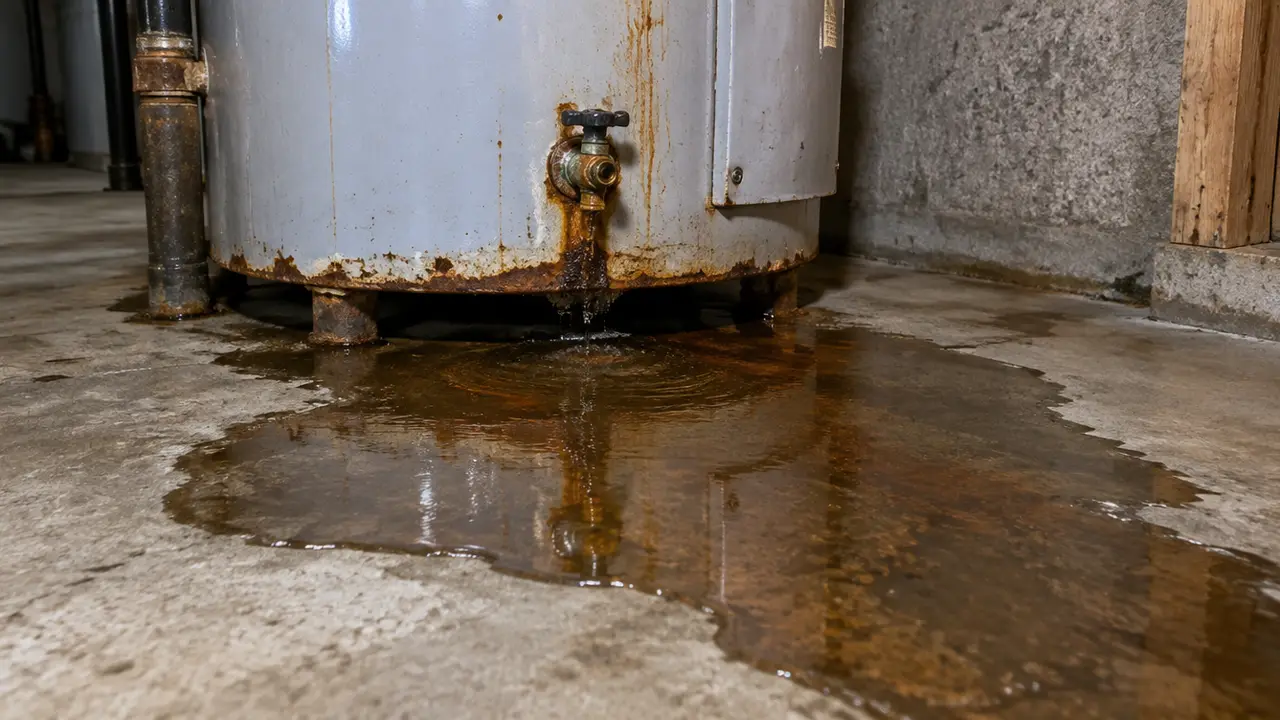
- A leak from the tank body is Replace now at any age; rust-coloured hot water with an age inside the range is Replace soon.
- It plans a replacement on your schedule; it cannot see inside your tank.
Tank Lifespan Predictor
01 /What does the lifespan predictor do?
The predictor turns a vague worry ("our tank is getting old") into a planning decision. Almost every storage tank eventually fails the same way: the anode rod is used up, the steel tank corrodes, and one day it leaks. Tanks rarely give much warning, and a failure usually means an emergency call, a wet floor and whatever tank is available that day. Knowing roughly where your heater sits in its life lets you replace it on your own schedule, compare options and quotes properly, and avoid a flooded basement.
The tool is deliberately simple. It uses published-style life ranges as an editorial starting point, adjusts them for the three factors that most change how fast a tank wears, and compares your heater's age with the result. It shows its reasons, so you can see exactly why it placed your tank in a band.
02 /What do you enter?
| Input | Options | Why it matters |
|---|---|---|
| Type | Gas tank, power vent, electric tank, heat pump, tankless | Sets the base life range |
| Age | Years since installation | Compared with the adjusted range |
| Water hardness | Soft, moderate or hard | Hard water builds scale and sediment faster |
| Flushing | Yearly, occasionally, or never | Removes sediment that overheats or buries heating surfaces |
| Anode replaced | Yes or no | A fresh anode restarts the tank's corrosion protection |
| Signs | Leak from the tank body; rust-coloured hot water | Failure signals that override the age-based band |
If you do not know the age, look at the rating plate. Most manufacturers encode the month and year of manufacture in the serial number; the manual or the maker's customer line can decode it. Installation is usually within a few months of manufacture. If you do not know your water hardness, your municipal water utility usually publishes it, and a home test strip gives a quick answer on a private well.
03 /How does the predictor calculate the band?
It works in three steps: a base range for the type, adjustments to both ends of that range, then a comparison with your heater's age.
| Type | Base range |
|---|---|
| Gas tank | 8–12 years |
| Power vent | 8–12 years |
| Electric tank | 10–15 years |
| Heat pump | 10–15 years |
| Tankless | 15–20 years |
| Condition | Adjustment |
|---|---|
| Hard water | −2 years |
| Moderate water | −1 year |
| Soft water | No change |
| Flushed yearly | +1 year |
| Never flushed | −1 year |
| Anode replaced | +2 years |
| Your heater's age | Band |
|---|---|
| Less than low − 2 | Healthy |
| From low − 2 up to low | Plan ahead |
| From low to high | Replace soon |
| Past high | Replace now |
Two failure signals override the arithmetic. A leak from the tank body is Replace now at any age, because a leaking steel tank cannot be repaired. Rust-coloured hot water with an age inside the range is Replace soon, because that combination usually means the anode is spent and the tank lining is corroding. Rusty water in a young tank is treated differently: it can come from galvanized pipes or a corroded fitting rather than the tank, and the checklist below shows how to tell the difference.
04 /Worked examples
| Heater | Adjusted range | Band edges | Age | Band | Remaining years |
|---|---|---|---|---|---|
| Gas tank, hard water, never flushed, original anode | 8–12 → 5–9 | Plan ahead from 3 | 9 | Replace soon | 0 to the high end |
| Electric tank, moderate water, flushed yearly | 10–15 → 10–15 | Plan ahead from 8 | 6 | Healthy | 4 to 9 |
| Gas tank, soft water, flushed yearly, anode replaced | 8–12 → 11–15 | Plan ahead from 9 | 7 | Healthy | 4 to 8 |
| Power vent, moderate water, never flushed | 8–12 → 6–10 | Plan ahead from 4 | 11 | Replace now | Past the range |
| Tankless, hard water, flushed yearly | 15–20 → 14–19 | Plan ahead from 12 | 12 | Plan ahead | 2 to 7 |
Compare the first and third rows: both are gas tanks, but hard water and no maintenance pull the first range down to 5–9 years, while soft water, yearly flushing and a replaced anode push the third up to 11–15. A nine-year-old tank would be Replace soon in the first house and Plan ahead in the third. Flushing and a replaced anode together add three years to both ends of a range. That is an editorial estimate of the effect of good maintenance, not a promise that maintenance will deliver it.
Remaining years are counted from your heater's age to the ends of the adjusted range. For the electric tank at six years with a 10–15 range, that is 4 to 9 years. For the gas tank already at the high end of its range, it is zero, which is why the band is Replace soon rather than Healthy even though the tank still works.
05 /What each band means for you
- Healthy: keep up maintenance. Check the T&P valve discharge pipe for drips, flush on the maker's schedule, and have the anode inspected every few years, sooner on softened water.
- Plan ahead: start the homework now while nothing is urgent. Decide whether you want the same type or a change, size it with the size calculator, and price the options with the cost guide. If you rent your tank, read your agreement now.
- Replace soon: get quotes and pick a date. Put a drain pan with a leak sensor under the tank if the space allows, and make sure everyone at home knows where the cold shut-off is.
- Replace now: the tank is past its adjusted range or is already leaking. If it is leaking, shut off the cold supply and the gas or power, then follow the leaking tank guide.
06 /A checklist to go with your result
- Confirm the age
Read the serial number on the rating plate and decode the manufacture date. Write it on the tank with a marker.
- Look for the two failure signals
Check the base and the sides of the tank for water, rust streaks or a wet ring on the floor. Fill a white cup from the hot tap and compare it with the cold tap.
- Separate tank rust from pipe rust
If only the hot water is rusty, the tank is the likely source. If both hot and cold are discoloured, suspect pipes or the supply and call your utility.
- Check the T&P valve discharge pipe
A damp or crusted pipe end means the valve has been releasing water; find out why before assuming the tank is failing.
- Plan the replacement
Choose a type, size it, check what the install will involve (gas line, venting, expansion tank, electrical) and collect quotes before the tank fails.
07 /Limits of the prediction
The predictor cannot see inside your tank. It does not know your temperature setting, how much hot water you use, whether the tank was installed with a thermal expansion tank, whether water softening has sped up anode wear, or whether the unit sat unused for months. Individual tanks fail both earlier and later than any range. Treat the band as a planning signal and your eyes as the final word: water at the base of the tank beats any calculation.
For the reasoning behind the ranges, read how long hot water tanks last and signs your water heater is failing. To keep a healthy tank healthy, follow the maintenance schedule. When you are ready to replace, you can request quotes.
FAQQuestions people ask
How long does a hot water tank last in Canada?
As an editorial planning range, gas and power-vent tanks commonly last 8 to 12 years and electric and heat pump tanks 10 to 15, with tankless units at 15 to 20. Hard water shortens that; flushing and anode replacement can extend it.
Should I replace a working 12-year-old gas water heater?
At 12 years a gas tank is at or past the top of its typical range, so planning a replacement is sensible even if it works. Replacing on your schedule avoids an emergency install after a leak.
Does replacing the anode rod make a tank last longer?
It can, if done before the tank has started to rust. The predictor adds two years for a replaced anode as an editorial estimate.
Can a leaking hot water tank be fixed?
A leak from a fitting, drain valve or the T&P valve can often be repaired. A leak from the tank body itself cannot, and the predictor treats it as Replace now.
Why is my hot water rusty?
If only the hot water is rusty, the tank lining is the likely source, often because the anode is spent. If both hot and cold are discoloured, the cause is more likely pipes or the water supply.