To flush a hot water tank, turn the gas control to pilot or off, or switch off the breaker for an electric tank, attach a hose to the drain valve, open a hot tap, and drain until the water runs clear, briefly opening the cold supply to stir the sediment. Refill completely, with a hot tap open until water flows steadily, before restoring heat.
- Flushing removes sediment that makes gas tanks rumble, buries electric elements and wastes energy.
- Always turn off the heat source first; an electric tank must be completely full before power is restored or the elements burn out.
- The drain water is hot enough to scald; let it cool or route the hose carefully to a drain.
- Yearly flushing from new works best; a first flush on an old, neglected tank can leave the drain valve leaking.
- Tankless units are not drained like this; they are descaled through service valves.
01 /Why flush a hot water tank?
Flushing a hot water tank removes the sediment that collects on its bottom. Hard water carries dissolved calcium and magnesium, and heating makes some of it drop out as scale. Scale flakes off the tank walls and elements and settles with any sand or grit from the supply. Over years, that layer can be several centimetres deep.
| Tank | Effect of sediment | What you notice |
|---|---|---|
| Gas (conventional or power vent) | Insulates the bottom from the water; steam bubbles form underneath; steel runs hotter | Rumbling and popping, slower recovery, higher gas use |
| Electric | Buries the lower element; scale coats elements | Hot water runs out sooner, sizzling, element failures |
| Heat pump (hybrid) | Settles over the lower element and around the tank bottom | Reduced capacity in electric backup, noises |
| Any tank | Takes up volume; clogs the drain valve | Less hot water; drain valve that will not seal |
Calgary's water is a good reason to take flushing seriously. The City's published hardness figures run from roughly 140 to 275 milligrams per litre as calcium carbonate depending on plant and season, which is hard water on most scales. Softer supplies, such as many in coastal British Columbia, produce much less.
02 /How often should you flush a water heater?
Once a year is the common starting point, and many manufacturers' manuals call for draining some water periodically to remove sediment. Adjust from there: hard water and heavy use justify more frequent partial flushes; soft water may allow longer intervals. Your manual is the authority for your model.
| Water | Interval | Notes |
|---|---|---|
| Hard (Calgary, much of the Prairies) | Every 6–12 months | Draining a few litres every few months between full flushes helps |
| Moderate | Every 12 months | A quick drain after big plumbing work clears grit |
| Soft or softened | Every 12–24 months | Softened water still carries grit; check the anode more often |
| Well water with sand | Every 6 months | A sediment filter upstream reduces the load |
03 /What do you need to flush a hot water tank?
- A garden hose long enough to reach a floor drain, laundry tub or outside, ideally one rated for hot water.
- Gloves and eye protection; the water can be hot and the sediment gritty.
- A bucket, to check how clear the water is running.
- A flat screwdriver or wide slot tool if your drain valve has a slotted stem rather than a handle.
- A garden-hose cap, in case the drain valve does not seal fully afterwards.
- Your tank's manual or the lighting and operating instructions on its label.
Check where the water will go before you start. A floor drain within reach is ideal. If the hose must run uphill to a window or through a wall, the tank will drain slowly or not at all, because a tank drains by gravity and supply pressure only.
04 /How do I flush a gas or electric hot water tank, step by step?
- Turn off the heat
Gas: turn the control knob to PILOT (or VACATION) so the burner cannot fire, or to OFF if you prefer. Power vent: also switch off or unplug the unit. Electric or heat pump: switch off the breaker. Never let an electric tank's elements run while the tank is empty.
- Let it cool, or be careful
The water can be close to 60 °C. Waiting an hour or two, or running hot water at a tap for a few minutes while the cold supply stays on, lowers the temperature and the scald risk.
- Connect the hose
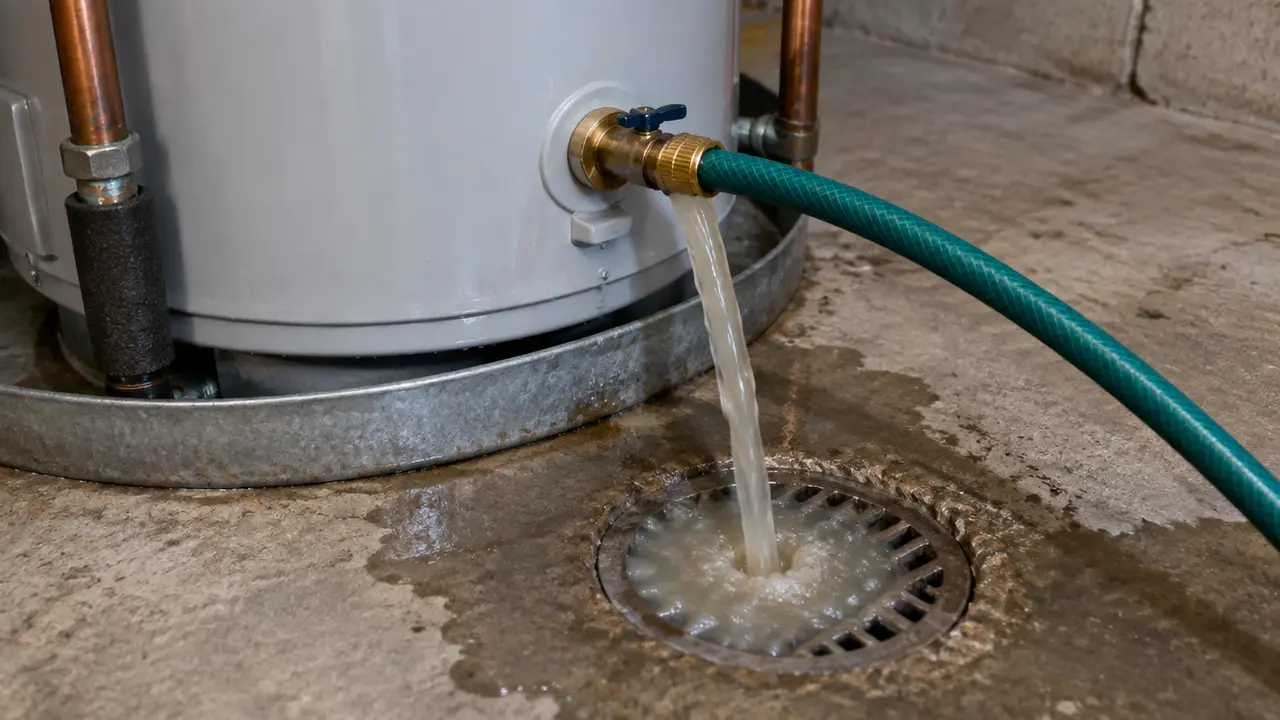
Screw the hose onto the drain valve at the bottom of the tank and run it to the floor drain or outside. Make sure the free end is secured so it cannot whip or spray.
- Open a hot tap
Open a hot tap on the floor above, or the nearest hot tap. This lets air in so the tank drains, and prevents a vacuum.
- Open the drain valve
Open it slowly. The first water often carries a burst of sediment. Watch it at the bucket or drain.
- Stir it up
For a full flush, close the cold supply valve at the top of the tank and let it drain. Then open the cold supply for a few seconds with the drain still open. The inrush stirs sediment off the bottom. Repeat until the water runs clear.
- Close the drain valve
Close it firmly but without forcing plastic valves. Remove the hose and watch the outlet for drips.
- Refill completely
Open the cold supply fully and leave the hot tap open. When water flows steadily from the tap with no sputtering air, the tank is full. Close the tap.
- Restore heat
Gas: turn the control from PILOT back to the setting you had; if the pilot went out, relight it by following the label. Power vent: restore power. Electric: switch the breaker on only after the tank is full.
- Check again in an hour
Look at the drain valve and fittings for drips and confirm the water is heating.
A partial flush, done every few months in hard water, is simpler: heat off, hose on, open the drain and let four or five buckets' worth run through with the cold supply on, then close up and restore heat. It will not remove packed sediment but it keeps new sediment from building.
05 /What goes wrong when flushing a hot water tank?
| Problem | Likely cause | What to do |
|---|---|---|
| Barely a trickle from the drain | Sediment clogging the valve | Open and close the cold supply to pulse it; stop if the valve feels fragile. A technician can fit a full-port drain valve |
| Drain valve drips after closing | Grit on the valve seat, or a worn plastic valve | Open and close it once more to flush the seat; cap it with a hose cap; replace the valve if it keeps dripping |
| Water never runs clear | Heavy, packed sediment | Several stir-and-drain cycles; on an older tank, consider whether it is near replacement |
| Sputtering taps afterwards | Air still in the tank or lines | Run each hot tap until the flow is smooth |
| No hot water afterwards (electric) | Breaker turned on before the tank was full, burning out an element | Test and replace the element; next time refill first |
| No hot water afterwards (gas) | Pilot went out during the flush | Relight using the label instructions; see no hot water |
Older tanks deserve a warning. If a tank has gone eight or ten years without a flush, the first flush can dislodge enough sediment to stop the drain valve from resealing, or to expose rusty spots that the sediment had been covering. That is not a reason to avoid flushing forever, but on a tank already near the end of its range, it is worth judging whether a first-ever flush is worth the risk. The Tank Lifespan Predictor helps with that call.
06 /How do you flush a tankless water heater?
A tankless water heater is not drained like a tank; it is descaled. Hard water leaves scale on the heat exchanger, which reduces flow and heat transfer and can trigger error codes. Units are usually installed with a pair of service valves with small side ports. The usual method isolates the unit, connects a small pump and hoses to the ports, and circulates a descaling solution approved by the manufacturer through the heat exchanger for the time the manual specifies, then rinses with clean water.
Follow the manual closely, especially on gas units, and clean the inlet water filter screen at the same time. If your unit has no service valves, installing them is a job for a plumber, and it makes every future descaling faster. For the differences between tank and tankless maintenance, see tankless vs tank.
07 /Should a professional flush my water heater?
Flushing a tank is a reasonable owner task on most gas and electric tanks. A plumber or technician makes sense if the drain valve is fragile or clogged, if the tank is old and you want someone to judge its condition, or if you want the flush combined with an anode inspection, a T&P valve check and a venting and combustion check on a gas unit. Many owners book this as a yearly service.
A stand-alone flush or maintenance visit is commonly quoted in roughly the $120–$300 range, more when an anode or drain valve is replaced at the same time.
If a flush turns up rusty water that will not clear, a leaking tank or a failed drain valve on an older tank, it may be time to plan a replacement. You can request quotes or keep a year-round routine with the maintenance schedule.
FAQQuestions people ask
Do I need to turn off the water to flush a hot water tank?
For a partial flush, no; the cold supply pushes water and sediment out. For a full flush, close the cold supply so the tank drains, then open it briefly to stir the sediment. Always turn off the heat source first.
Can I flush my water heater without draining it completely?
Yes. A partial flush with the cold supply on removes loose sediment and is a good habit every few months in hard water. A full drain with stirring removes more.
Why does my water heater not drain when I open the valve?
Usually sediment is clogging the drain valve, or no hot tap is open so air cannot enter. Open a hot tap and try pulsing the cold supply. If it still will not drain, a technician can clear it or fit a larger drain valve.
What happens if I turn on an electric water heater without water?
The elements burn out within seconds to minutes because nothing carries their heat away. Always refill completely, with a hot tap open until water flows steadily, before switching the breaker on.
Is it too late to flush an old water heater?
Not always, but a first flush on a tank that has gone many years without one can leave the drain valve dripping or reveal rust. On a tank near the end of its range, weigh the risk and consider a technician.
Does flushing a water heater make it more efficient?
Removing sediment helps heat reach the water, especially on gas tanks, and restores volume lost to sediment. The gain is largest on tanks with heavy build-up.