An anode rod is a sacrificial metal rod, usually magnesium or aluminium alloy, screwed into the top of a water heater tank. It corrodes so the tank's steel does not. When the rod is spent, the tank starts to rust from inside. Checking it every few years and replacing it before it is gone is the most effective way to extend a tank's life.
- The anode protects the steel wherever the glass lining has flaws; without it, those spots rust through.
- Magnesium protects most strongly but can cause a rotten-egg smell in some water; aluminium-zinc alloys and powered anodes are the usual fixes.
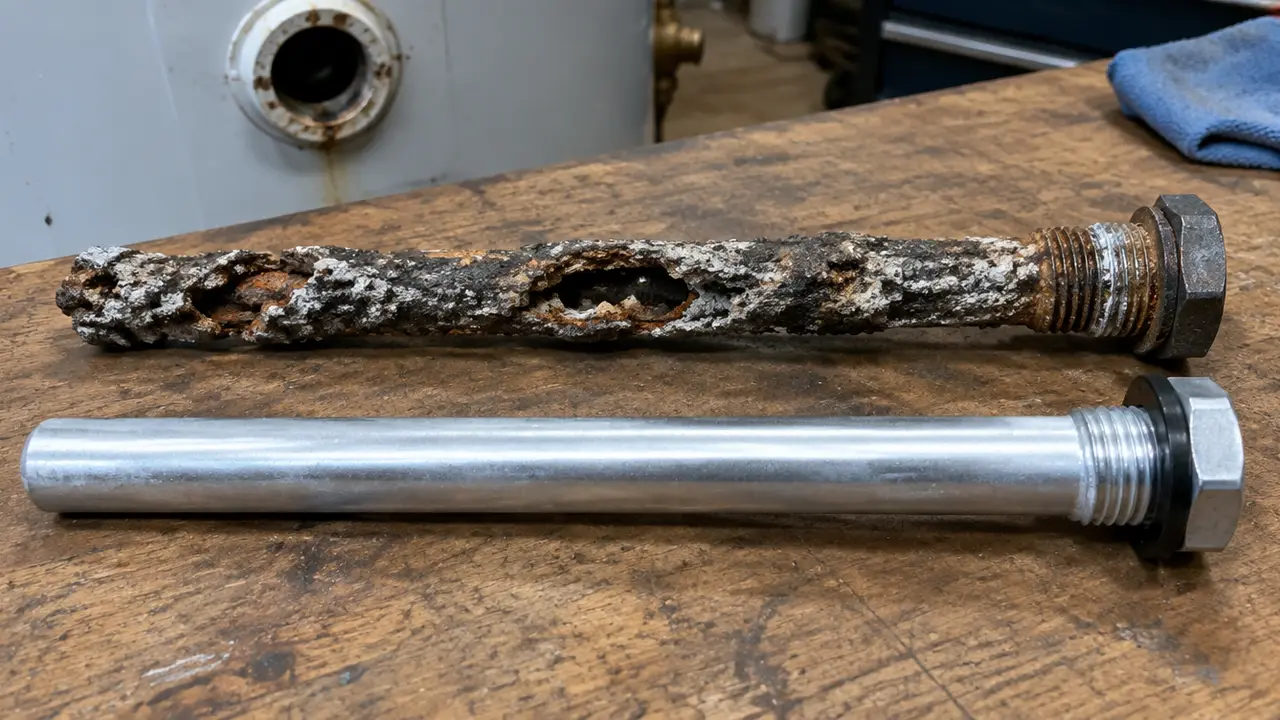
- Inspect at 3–5 years, sooner with a water softener; replace when the core wire shows along much of the rod.
- Never leave a tank without an anode: it shortens tank life and can void the warranty.
- Tank-type heat pump water heaters have anodes; tankless units do not.
01 /What does an anode rod do in a water heater?
An anode rod protects a water heater's steel tank from corrosion by corroding in its place. Inside the tank, the steel is coated with a glass-like enamel, but no lining is perfect: welds, fittings and tiny flaws leave bare steel exposed to hot water. The anode is a more reactive metal electrically connected to the tank. In the water, the two form a galvanic cell. The anode gives up metal and electrons; the steel at the flaws is protected. Natural Resources Canada's Water Heater Guide describes the anode as a magnesium or aluminium alloy rod inserted from the top, dissolving at a rate that depends on the water's hardness or mineral content and on the integrity of the tank's coating.
The practical consequence is simple. While there is anode metal left, the tank is protected. Once the rod is down to its steel core wire, the tank's own steel becomes the sacrificial metal, and the tank begins its countdown to a leak. See how long hot water tanks last for how this sets a tank's lifespan.
02 /Which anode rod type is best?
No single anode is best for every home; the right one depends on your water. Magnesium gives the strongest protection and is the usual factory choice for soft to moderate water. Aluminium alloys are often chosen where magnesium is consumed quickly. Aluminium-zinc alloys are the common swap for rotten-egg odour. Powered anodes do not dissolve at all and suit odour problems and softened water.
| Type | How it works | Best for | Watch out for |
|---|---|---|---|
| Magnesium | Most reactive common alloy; strongest protective current | Soft to moderate water; most standard tanks | Consumed fast in softened water; can feed rotten-egg odour where sulphate and bacteria are present |
| Aluminium alloy | Less reactive than magnesium; often recommended for hard water | Water where magnesium rods are consumed quickly | Gel-like corrosion residue in some water; some owners prefer to avoid aluminium |
| Aluminium-zinc alloy | Aluminium with a zinc content that helps suppress hydrogen sulphide odour | Hot water that smells of rotten eggs | Reduces odour but may not eliminate it if bacteria are established |
| Powered (impressed current) | A titanium electrode fed a small current from a plug-in power supply; does not dissolve | Odour problems, softened water, long-term ownership | Needs continuous power; costs more; must suit the tank's opening |
| Flexible or segmented | Any alloy in linked segments | Low ceilings with little clearance above the tank | Same chemistry as the alloy it is made of |
| Combination (outlet) anode | Anode built onto the hot outlet nipple | Tanks designed with one; often a second anode | Must be replaced as an outlet fitting |
Are anode rods universal? Many residential tanks use a similar thread and hex size (a 1-1/16 inch socket fits many), but lengths, thread sizes and positions vary, and some tanks have two anodes or an outlet anode. Check the tank's manual or rating plate before buying, and keep the replacement at least as long as the original unless you use a segmented rod for clearance.
03 /How often should an anode rod be checked or replaced?
Check the anode for the first time at three to five years, then every one to two years after that, or as your manual says. Replace it when the steel core wire is visible along a good part of its length or the rod has lost most of its thickness. Those are rules of thumb; the rod's condition, not the calendar, decides.
| Water | First check | Then |
|---|---|---|
| Soft or moderate, not softened | 4–5 years | Every 2 years |
| Hard (such as Calgary's supply) | 3–4 years | Every 1–2 years |
| Softened | 2–3 years | Every 1–2 years |
| Well water, odour issues | 2–3 years | Yearly while you are managing odour |
Anode replacement earns a full two years in the Tank Lifespan Predictor, more than any other adjustment. A tank whose anode is renewed once in mid-life often reaches the top of its range.
04 /How do I replace a water heater anode rod?
- Find the anode
Look for a hex head on the top of the tank, sometimes under a plastic cap or the insulation. If the only fitting is on the hot outlet, the tank may have an outlet anode.
- Turn off the heat and water
Gas: control to PILOT or OFF. Electric or heat pump: breaker off. Close the cold supply valve.
- Relieve pressure
Open a hot tap. Then drain a few litres from the drain valve so the water level drops below the anode port.
- Break it loose
Use a 1-1/16 inch socket (or the size that fits) on a long breaker bar. Anodes are ordinary right-hand threads: counter-clockwise to loosen. They are often very tight; an impact wrench helps. Brace the tank so it does not rotate.
- Inspect the old rod
Photograph it. Pencil-thin, pitted or bare core wire over much of its length means it was due.
- Prepare the new rod
Wrap the threads with the sealant the manufacturer specifies, commonly PTFE tape or potable-water pipe dope.
- Install and tighten
Thread it in by hand first, then tighten firmly. A flexible rod can be bent to fit under a low ceiling.
- Refill and check
Open the cold supply with a hot tap open until water flows steadily, close the tap, check the port for leaks, then restore heat.
Rods that will not budge are common on older tanks. A plumber has impact tools and experience with seized anodes, and can judge whether a stubborn rod on an old tank is worth the fight or whether the tank is close to replacement anyway.
05 /Can an anode rod cause rotten-egg smelling hot water?
Yes. The New Brunswick government's well-water fact sheet explains that magnesium corrosion control rods can, under the right conditions, chemically reduce naturally occurring sulphates to hydrogen sulphide, and that sulphate-reducing bacteria thrive on the hot water side. The smell is strongest in hot water, especially after the tank has sat unused.
The same fact sheet is clear that removing the magnesium rod without replacing it with a different type voids the water heater warranty and can lead to earlier tank deterioration. The fix is a different anode, usually aluminium-zinc or powered, sometimes combined with disinfection. The full sequence is in rotten egg smell in hot water.
Never solve an odour by pulling the anode out. You trade a smell you can fix for a tank that rusts through.
06 /What does an anode rod replacement cost?
The rod itself is the small part of the cost. Magnesium and aluminium rods are commonly about $30–$90 depending on length and type; powered anodes are more, commonly about $150–$350. A plumber's visit to replace an anode, including the rod, is commonly quoted around $150–$400, higher if the rod is seized or the tank needs a segmented rod for clearance.
Set against the cost of a new tank and installation, a timely anode replacement is one of the best-value jobs in home maintenance, provided the tank is still dry and its hot water clear. On a tank that is already leaking or producing rusty water, a new anode is too late. For that situation, see the replacement cost guide or request quotes.
FAQQuestions people ask
Is it OK to remove the anode rod from a water heater?
No. Without an anode, the tank's steel corrodes at every flaw in its lining and the tank's life is cut short. Removing it without a replacement can also void the warranty. Replace it with a different type if the original caused problems.
Do heat pump water heaters have anode rods?
Yes. A heat pump water heater stores water in a steel tank like any other, so it has one or more anodes. Tankless water heaters do not use anode rods.
Is the anode rod on the hot or cold side?
It is usually in its own port on the top of the tank, separate from the hot and cold connections. On tanks with an outlet anode, it is built onto the hot outlet nipple.
Can I cut an anode rod to fit?
Cutting a rod removes protective metal and can leave the core exposed. For low ceilings, a flexible or segmented anode of the full length is the better choice.
Is an anode rod covered under warranty?
Anodes are generally treated as consumable parts. The tank warranty assumes the anode is maintained; read your warranty's terms and keep receipts for anode replacements.
How many anode rods are in a water heater?
Most residential tanks have one; some larger or longer-warranty tanks have two, often one standalone and one built onto the hot outlet.
Does the anode rod affect hot water?
It can: a magnesium rod can contribute to rotten-egg odour in some water, and a spent rod lets rust colour the hot water. A healthy rod of the right type has no noticeable effect.