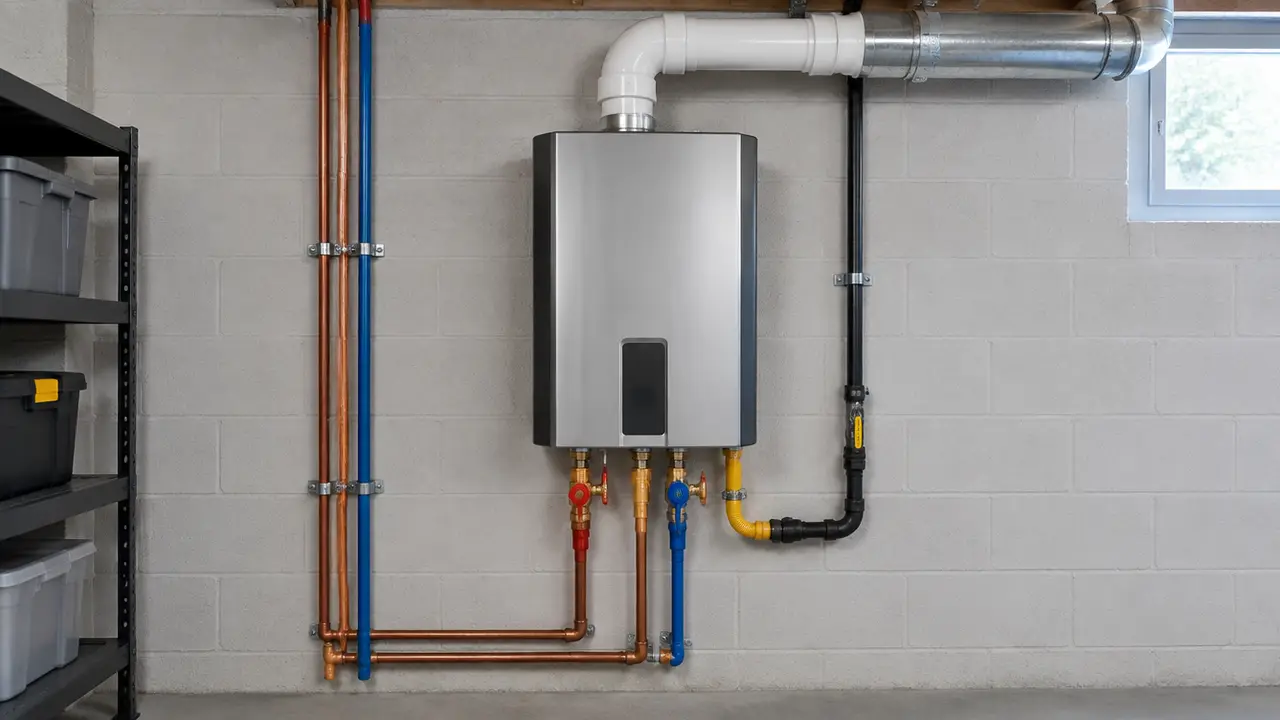
A tankless water heater needs its heat exchanger descaled on the schedule in its manual, sooner in hard water, plus a clean inlet water screen, clear air intake and vent terminations, and an open condensate drain on condensing units. Descaling means closing the isolation valves and pumping a descaling solution through the unit from a bucket. A yearly professional check covers combustion and venting.
- Scale is the main threat: it narrows the heat exchanger's passages, restricts flow and shortens the unit's life.
- Descaling circulates an approved solution through the service ports on the isolation valves with a small pump, then flushes the unit with clean water.
- A U.S. Department of Energy guideline reports manufacturers' flushing intervals ranging from twice a year to once every three years; harder water and heavier use push toward the short end.
- Health Canada calls hardness above 200 mg/L poor, and Calgary's published figures run from about 141 to 274 mg/L, so many Canadian owners should plan on frequent descaling.
- Clear vents after snowfalls, keep the condensate line open, and book a professional inspection at least yearly or as the manual directs.
01 /What maintenance does a tankless water heater need?
A tankless water heater has no tank to rust through and no sediment bed to flush, but its care is less forgiving: its heat exchanger is a set of narrow passages, and anything that coats or blocks them shows up quickly as lower flow, temperature swings and error codes. Your manual sets the exact intervals and methods.
| Task | Why it matters | How often | Who |
|---|---|---|---|
| Descale the heat exchanger | Scale restricts flow and heat transfer | Per the manual; sooner in hard water (see below) | Owner, if service valves are fitted and the manual allows; otherwise a pro |
| Clean the inlet water screen | Grit and scale flakes choke the flow | At every descaling, and whenever flow drops | Owner |
| Check the air intake or filter | Lint and dust starve the burner of air | Every few months where the unit uses room air | Owner |
| Inspect vent terminations | Snow, ice or nests block the exhaust | During and after snowstorms, and each season | Owner |
| Check the condensate line and neutralizer | A blocked or frozen line shuts the unit down | At each service; neutralizer media as the manual says | Owner checks; pro replaces |
| Professional inspection | Combustion, gas pressure, venting and safety controls | At least once a year, or as the manual directs | Licensed gas technician |
Health Canada's carbon monoxide advice is the baseline for the last two rows: have fuel-burning appliances inspected by a professional at least once a year or in line with the manufacturer's instructions, and inspect exhaust vents during and after snowstorms.
02 /Why does scale matter so much in a tankless heater?
Scale matters more in a tankless heater because it forms exactly where the water is heated, in passages too narrow to tolerate it. A U.S. Department of Energy measure guideline explains that in a tank, scale settles at the bottom and has much less effect on flow and performance, while in a tankless unit it builds up in the heat exchanger, restricts the flow of water and diminishes the life of the unit. Health Canada notes that hardness causes scaling of hot water pipes, boilers and other household appliances, and that the deposits depend on pH and temperature, which helps explain why heated surfaces scale fastest.
Natural Resources Canada's Water Heater Guide calls water quality the single most important factor affecting the life of a water heater. In a tankless unit the early signs of scale are hot flow weaker than the cold, temperature that wanders during a shower, and overheating or low-flow error codes.
03 /How hard is your water, and how often should you descale?
Descale as often as your manual requires for your water hardness, and treat that as a floor rather than a target. The U.S. Department of Energy guideline reports that manufacturers recommend flushing anywhere from twice a year to once every three years, depending on the model, how often it runs and the water quality. It adds that some manufacturers may require a water softener where hardness exceeds about 8 to 14 grains per gallon (136 to 239 mg/L).
Health Canada's guidance gives the scale for judging your own water: 80 to 100 mg/L as calcium carbonate is an acceptable balance between corrosion and scaling, supplies above 200 mg/L are considered poor but tolerated, and above 500 mg/L are unacceptable for many domestic purposes. The City of Calgary's published hardness runs from about 141 to 200 mg/L at its Bearspaw plant and 181 to 274 mg/L at Glenmore, hardest in midwinter and softest during spring melt. Find your own figure in your municipality's water quality report, or test a private well.
| Hardness (mg/L as CaCO3) | Grains per gallon | Where it sits | Planning interval |
|---|---|---|---|
| Under 80 | Under about 5 | Below Health Canada's acceptable-balance band | The manual's longest interval; inspect yearly |
| 80 to 136 | About 5 to 8 | Acceptable to moderately hard | About once a year |
| 136 to 200 | About 8 to 12 | Where some makers start to require softening | Every 6 to 12 months; ask about treatment |
| Over 200 | Over about 12 | Health Canada's "poor" range | About every 6 months, and check whether the manual requires treatment |
Grains per gallon are mg/L divided by about 17.1. Heavy use shortens every interval.
04 /How do you descale a tankless water heater?
You descale a tankless heater by isolating it from the house plumbing and pumping a descaling solution through it in a loop from a bucket. That needs a set of isolation valves, sometimes called service valves, on the cold and hot connections, each with a small side port for a hose. If your unit has none, have a plumber fit them; every future descaling becomes routine instead of a plumbing project.
- Gather the kit
A small submersible or utility pump, two washing-machine-style hoses, a bucket, the descaling solution the manual specifies, and towels.
- Shut off heat and isolate
Turn off power to the unit, and gas if instructed. Close the cold and hot isolation valves so the unit is cut off from the house.
- Relieve pressure
Open the service ports slowly with a bucket underneath, or as the manual directs, to release trapped pressure and drain what it tells you to.
- Connect the loop
Run a hose from the pump outlet to the cold-side service port, and a second hose from the hot-side service port back into the bucket.
- Circulate
Put the amount of solution the manual specifies in the bucket, open both service ports and run the pump for the time the manual gives. Discoloured or fizzing solution returning to the bucket is scale dissolving.
- Rinse
Drain the bucket. Point the return hose at a drain, close the cold service port, and open the cold isolation valve so fresh water flushes the unit for several minutes.
- Clean the inlet screen
Remove the inlet water filter screen, rinse it with a soft brush and refit it, checking its seal.
- Restore and check
Close the ports, remove the hoses, open both isolation valves, run a hot tap to purge air, then restore power and gas and check for leaks and error codes.
05 /Should you use vinegar or a manufacturer's descaler?
Use whatever your manual approves. Both are acids that dissolve calcium carbonate scale, but manuals differ: some allow food-grade white vinegar, a mild household acid, while others name a type of descaling solution, sometimes made with inhibitors to protect metals, and warn against substitutes. The heat exchanger's metals and seals and the warranty terms sit behind those instructions. Never mix chemicals, never use drain cleaners or acids the manual does not list, and dispose of spent solution as its label and your municipality direct.
06 /How do you check the inlet screen, air intake and vents?
Check them by sight and by symptom. The inlet water screen is a small mesh filter at the cold connection that catches grit and scale flakes. A clogged one lowers the flow and can stop the unit firing at all, because a tankless heater needs a minimum flow to start; rinse it whenever the hot flow drops. Units that take combustion air from the room may have an air intake screen or filter that laundry lint and renovation dust clog; sealed-combustion units draw air through an outdoor pipe instead.
Vent terminations need the most attention in a Canadian winter. Drifts, icicles, frost, nests and leaves can block them, and a damaged vent can leak exhaust indoors. After every heavy snowfall, clear the terminations by hand and look along indoor vent pipe for loose joints or cracks. Keep a working carbon monoxide alarm; Health Canada says the most important place for one is in hallways outside sleeping areas. See the carbon monoxide guide.
07 /How do you look after the condensate drain?
Keep it open, primed and protected from freezing. A condensing tankless unit cools its exhaust until water condenses out of it, and the U.S. Department of Energy guideline notes that this condensate must be removed. It is mildly acidic, so it usually passes a trap and often a neutralizer cartridge on its way to a floor drain or pump. Check that the line is not kinked, that the trap holds water as the manual describes, and replace the neutralizer media on the manual's schedule. In a cold room, a frozen line backs water into the unit and shuts it down, so insulate or reroute it.
08 /What do tankless error codes usually mean?
Error codes differ by maker, so your manual's table is the only reliable decoder, but most fall into a handful of families with similar first checks.
| Kind of fault | Usual causes | Safe first step |
|---|---|---|
| Ignition or flame failure | Gas valve closed, supply interrupted, blocked intake or vent, dirty flame sensor | Check the gas valve and vents; reset once per the manual |
| Low flow or no activation | Clogged inlet screen, partly closed valve, flow below the minimum, scale | Clean the screen, open the valves, try a higher flow |
| Overheat or high limit | Scale in the heat exchanger, very low flow, a failing sensor | Descale; call a technician if it returns |
| Exhaust or air pressure fault | Snow, ice or a nest in the vent; blocked condensate line | Clear the termination and check the condensate line |
| Maintenance or scale reminder | Run-time counter or scale detection on some models | Descale, then reset as the manual describes |
| Freeze protection or sensor fault | Very cold room, power loss in a cold snap, failed sensor | Restore heat and power; sensors are a technician's job |
Freezing deserves a Canadian footnote: many units protect themselves with small electric heaters that need power, so a long outage in a cold snap puts a unit in a cold room at risk, and many manuals explain how to drain it. The Water Heater Troubleshooter also ranks tankless causes.
09 /When should you call a professional?
- Gas smell or a carbon monoxide alarm. Leave the house and call your gas utility or 911 from outside.
- Soot, scorch marks, a flame problem or a leak inside the cabinet.
- Ignition, flame or exhaust errors that return after you have cleared the vents and checked the gas valve.
- No isolation valves, damaged vent pipe or an electrical fault.
- The yearly inspection, where combustion, gas pressure and venting are tested with instruments.
As a planning estimate, a stand-alone maintenance visit is commonly quoted in roughly the $120 to $300 range used in this site's tank flushing guide, more when isolation valves are fitted or parts replaced at the same time. If you are still choosing a unit, tankless water heater sizing covers flow and gas supply, and you can request quotes that list descaling and valves as separate lines.
FAQQuestions people ask
Does a tankless water heater need to be flushed?
Yes. Flushing a tankless unit means descaling its heat exchanger by circulating a descaling solution through the isolation valves, then rinsing. How often depends on the manual, your water hardness and how much hot water you use.
How often should you descale a tankless water heater in hard water?
Follow the manual first. As a planning starting point, water above about 200 mg/L (roughly 12 grains per gallon) suits descaling about every six months, and many makers ask for water treatment at that level.
Can I use vinegar to descale my tankless water heater?
Only if your manual allows it. Some manufacturers accept food-grade white vinegar; others specify a particular descaling solution and warn that substitutes can damage parts or affect the warranty.
Do I need a water softener for a tankless water heater?
Not always, but in hard water it helps. A U.S. Department of Energy guideline notes some manufacturers may require softening above about 8 to 14 grains per gallon, so check your manual and your water report.
Why is my tankless water heater not heating?
Check that the gas valve and isolation valves are open, the inlet screen is clean, the vents are clear and the flow is high enough to fire the unit. Then read the error code in the manual. Repeated ignition or flame codes need a technician.
SOURCESSources and further reading
- U.S. Department of Energy, Building America — Measure Guideline: Transitioning to a Tankless Water Heater (PDF)
- Health Canada — Guidelines for Canadian Drinking Water Quality: Operational parameters (hardness)
- City of Calgary — Water quality, water hardness and water data
- Health Canada — Preventing carbon monoxide exposure
- Natural Resources Canada — Water Heater Guide (PDF)