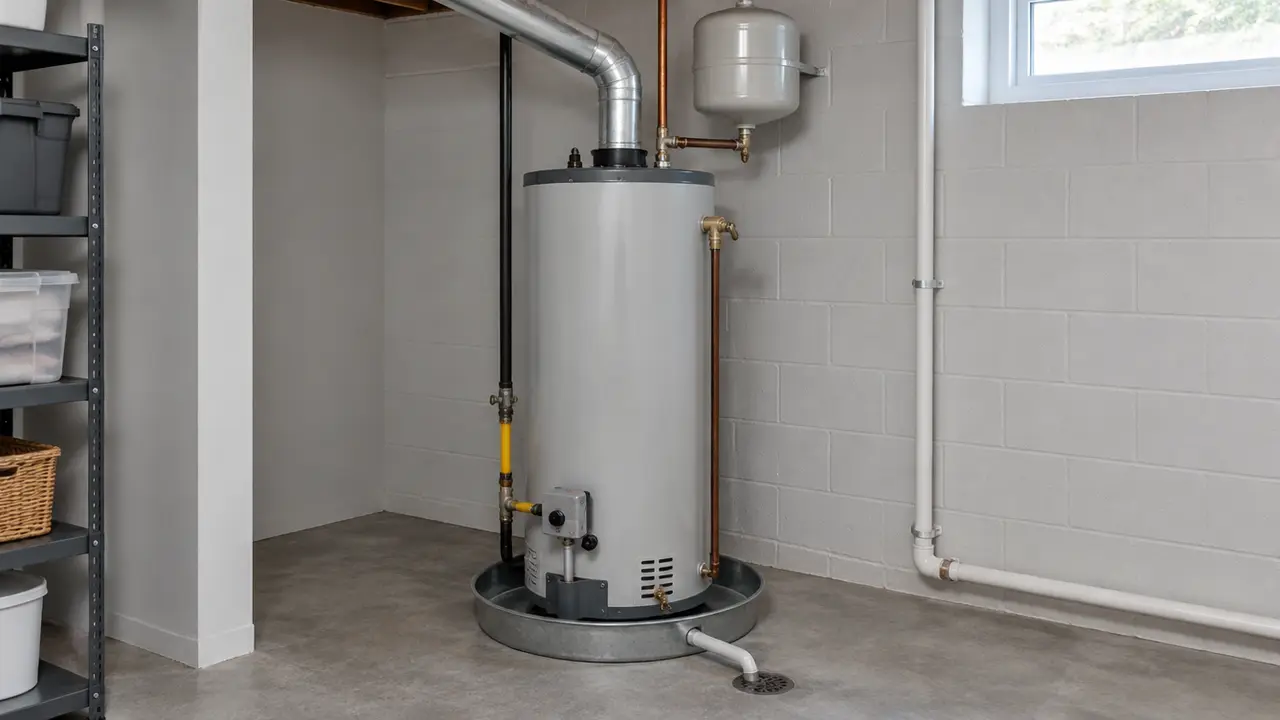
A hot water tank is an insulated steel tank, lined with glass, that holds water at house pressure and keeps it hot. Cold water enters through a dip tube to the bottom, a gas burner or electric elements heat it, and hot water leaves from the top when a tap opens. A thermostat controls the temperature, an anode rod protects the steel from rust, and a T&P valve protects against excess temperature or pressure.
- Cold water enters at the top but is piped to the bottom by the dip tube; hot water leaves from the top.
- Gas tanks heat from a burner under the tank and vent exhaust through a central flue; electric tanks use an upper and a lower element and need no vent.
- Hot water rises and forms layers (stratification), which is why a tank delivers steady heat and then runs cold quickly.
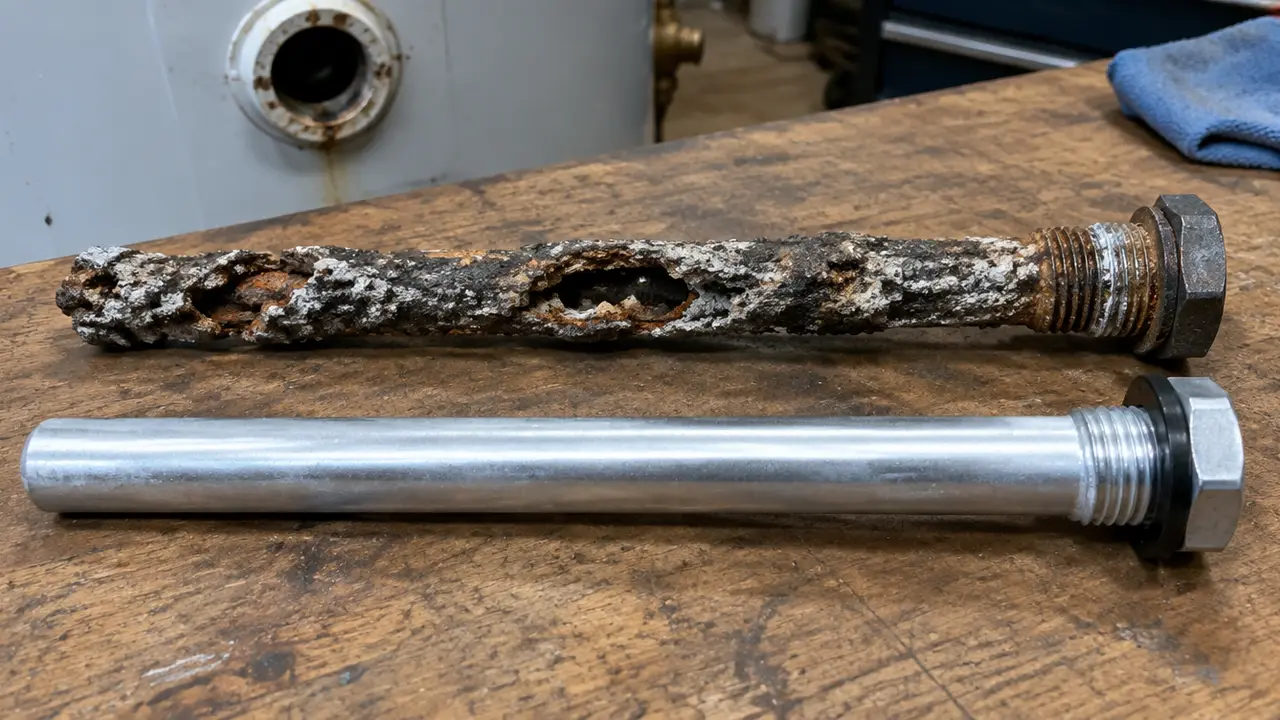
- The anode rod corrodes so the tank does not; once it is used up, the tank starts to rust.
- The T&P valve and an expansion tank manage pressure; never cap a T&P valve.
01 /What does a hot water tank actually do?
A hot water tank stores a supply of heated water so it is ready the moment you open a tap, and reheats what you use. It is connected directly to your cold water supply, so the water inside is at the same pressure as the rest of your plumbing, often somewhere between 40 and 80 psi in a house. That is why a hot tap runs as strongly as a cold one, and why a tank needs safety devices: it is a closed, pressurized vessel full of hot water.
Nearly every residential storage tank in Canada shares the same core design: a steel cylinder with a glass (porcelain enamel) lining on the inside, foam insulation around it, and a painted steel jacket on the outside. The differences between types are in how heat gets in and what happens to the leftovers. A gas tank burns natural gas or propane under the tank and must vent the exhaust. An electric tank has heating elements inside the water and needs no vent. A heat pump tank moves heat in from the surrounding air. The types of water heaters guide compares them all; this guide explains the tank itself.
A hot water tank is a pressure vessel with a heater attached. Every safety part on it exists because of that.
02 /What path does the water take through the tank?
Water takes a deliberate path so that the hot water you draw is not diluted by the cold water replacing it.
- Cold inlet
Cold water enters through a connection on top of the tank, usually below a shut-off valve on the cold pipe. That valve is the most important one to know: closing it stops water entering the tank during a leak.
- Dip tube
Inside, a plastic dip tube carries the cold water down to near the bottom of the tank. This keeps incoming cold water away from the hot outlet at the top.
- Heating
The burner or the lower element heats the water near the bottom. Heated water becomes less dense and rises.
- Hot outlet
Hot water leaves through a connection at the top, often through heat-trap fittings that stop hot water drifting up into the pipes when no tap is open.
- Replacement and recovery
Every litre drawn from the top is replaced by a litre of cold water at the bottom. The thermostat senses the drop in temperature and starts heating again.
If the dip tube cracks or falls apart, cold water enters at the top and mixes straight into the outlet. The result is a tank that seems to run out of hot water much too quickly, even though it heats normally. On older tanks, broken-down dip tube pieces sometimes show up as small plastic flecks in faucet aerators.
03 /How does a gas water heater heat the water?
A gas tank heats water from below with a burner in a combustion chamber under the tank floor, and sends the exhaust up through a tube, the flue, that runs through the centre of the tank.
- Gas control valve and thermostat. The dial on the front of the tank sets the water temperature. A temperature sensor in the water tells the valve when to open the main burner. The valve also contains a safety shut-off that closes the gas if the pilot or flame is not proven.
- Pilot or igniter. Older and many current tanks keep a small standing pilot flame that lights the main burner. A thermocouple or thermopile in the pilot flame proves it is lit. Newer tanks may use an electronic igniter instead.
- Burner. A ring of blue flame under the tank floor. Lint and dust around the air openings can starve it, turning the flame yellow and sooty.
- Flue and baffle. The flue carries hot exhaust up through the water, and a twisted metal baffle inside it slows the gases so more heat passes into the water before they leave.
- Draft hood or fan. On an atmospheric (natural draft) tank, a draft hood on top mixes room air with the exhaust and steadies the draft into a chimney or metal vent. On a power-vent tank, a fan pushes the exhaust out through plastic pipe instead.
Two safety points follow directly from this design. First, the burner needs combustion air, so a gas tank must never be boxed in, wrapped over its air openings, or surrounded by stored paint cans and solvents. Second, the exhaust contains carbon monoxide. If the vent is blocked or the house is depressurized by exhaust fans, exhaust can spill back into the room. Natural Resources Canada lists melted plastic fittings on top of a water heater as a sign of combustion spillage. Every home with a fuel-burning water heater should have working carbon monoxide alarms. See venting and backdraft.
04 /How does an electric water heater heat the water?
An electric tank heats water with resistance elements that sit directly in the water: usually an upper element and a lower element, each with its own thermostat behind a small access cover on the side of the tank.
In most residential electric tanks, the two elements take turns rather than running together. When the tank is cold, the upper element heats the top so some hot water is available quickly; once the top is satisfied, power switches to the lower element, which heats the rest of the tank. Day to day, the lower element does most of the work, because cold water enters at the bottom. A high-limit switch, usually with a red reset button near the upper thermostat, cuts power if the water gets dangerously hot.
Because nothing burns, an electric tank has no flue, no vent and no carbon monoxide risk from the heater itself. The trade-offs are slower recovery and, in most provinces, a higher running cost per unit of heat than natural gas. Electric tanks run on 240 volts, so any work behind the element covers must start with the breaker off. The gas vs electric guide compares the two.
05 /Why is the top of the tank hotter than the bottom?
Hot water is less dense than cold water, so it floats. Inside a tank, water arranges itself in layers, hottest at the top and coolest at the bottom. This is called stratification, and it is why a tank can deliver steady hot water through a whole shower and then turn cold within a minute: you are drawing off the hot layer while cold water fills in from below.
Stratification also matters for health. The National Research Council notes that in electric storage tanks, storing water below 60 °C may allow Legionella bacteria to grow because of temperature stratification, and that the National Plumbing Code 2015 requires electric storage-type water heaters to be set at 60 °C. The Public Health Agency of Canada advises setting water heaters to 60 °C and using mixing valves set to about 49 °C at faucets, showers and tubs to prevent scalds. The temperature setting guide explains how to do both.
06 /What protects the tank from bursting and rusting?
Three parts protect the tank: the T&P valve against excess temperature and pressure, the expansion tank against pressure build-up from heating, and the anode rod against corrosion.
The T&P valve (temperature and pressure relief valve) sits on the top or upper side of the tank. It opens if the water gets too hot or the pressure too high, releasing water so the tank cannot become a steam hazard. Residential valves are commonly rated to open at about 150 psi or near 99 °C (210 °F); the tag on the valve gives its exact rating. A discharge pipe carries released water down toward the floor or a drain so it cannot spray anyone. The valve and pipe must never be capped, plugged or reduced. A T&P valve that drips is telling you something; the T&P valve guide explains what.
The expansion tank is a small tank on the cold line with an air cushion behind a rubber bladder. Water expands as it heats. In a house where a check valve, backflow preventer or pressure-reducing valve stops water flowing back into the city main, that extra volume has nowhere to go, and pressure spikes every heating cycle. The expansion tank absorbs it. Without one, the T&P valve may drip after every cycle. See expansion tanks.
The anode rod is a rod of magnesium or aluminum, screwed into the top of the tank, that corrodes on purpose. Because it is more reactive than steel, electrochemical corrosion attacks it first, protecting any steel exposed through tiny gaps in the glass lining. When the anode is used up, the tank itself begins to rust from the inside, and a leak follows. That is why anode inspection is the single most useful maintenance item on a tank. See anode rods.
07 /What goes wrong as a tank ages?
Most tanks fail in a predictable sequence. Minerals in the water settle as sediment on the tank floor. On a gas tank, sediment insulates the water from the burner, so the steel floor runs hotter and the water trapped in the sediment flashes to steam, which is the rumbling and popping many old tanks make. On an electric tank, sediment builds around the lower element and shortens its life. Meanwhile the anode is consumed. Once it is gone, corrosion moves to the tank, and eventually the tank leaks.
| Part | Job | Usual failure | Typical sign |
|---|---|---|---|
| Dip tube | Delivers cold water to the bottom | Cracks or breaks up | Hot water runs out fast |
| Thermostat | Controls temperature | Drifts or fails | Water too hot or lukewarm |
| Pilot, thermocouple or igniter | Lights and proves the flame | Wears or gets dirty | Pilot won't stay lit |
| Elements | Heat the water electrically | Burn out | No hot water or not enough |
| Anode rod | Corrodes instead of the tank | Consumed | Rust in hot water, then a leak |
| T&P valve | Relieves temperature and pressure | Weeps or seizes | Drips from the discharge pipe |
| Tank | Holds pressurized water | Corrodes through | Water under the tank |
Most of these parts can be replaced. A leaking tank body cannot. The Tank Lifespan Predictor estimates where your tank sits in its life, and signs your water heater is failing lists what to watch for.
08 /What do recovery and first-hour rating mean?
Recovery is how fast a tank reheats water; first-hour rating (FHR) is how much hot water it can deliver in a busy hour, combining what it stores with what it recovers. Both depend on heating power. As an illustration, a 4.5 kW electric element can warm about 92 litres an hour by 42 degrees (4.5 × 3,600 ÷ (4.186 × 42)). A gas burner of 40,000 BTU/h is about 11.7 kW of input; if roughly three-quarters of that reaches the water, it heats nearly twice as much. That difference is why a gas tank of the same size has a higher FHR than an electric one. The Hot Water Morning Simulator plays recovery out minute by minute, and why hot water runs out in winter shows how cold incoming water slows it.
When you replace a tank, compare FHRs, not only gallons. The Water Heater Size Calculator estimates your peak-hour demand and matches it to a typical FHR, and the Tank Explorer lets you click through every part described here. If you need a tradesperson, you can request quotes.
FAQQuestions people ask
Is a hot water tank pressurized?
Yes. It is connected to your cold water supply, so the water inside is at house water pressure. That is why it has a T&P valve and, in closed systems, an expansion tank.
Does a hot water tank need electricity?
An electric tank does. Many atmospheric gas tanks with a standing pilot and a thermopile-powered control do not, so they keep heating in a power outage. Power-vent, electronic-ignition and heat pump units need power.
Why do hot water tanks have a pipe down the side?
That is the discharge pipe from the T&P valve. It carries any released water toward the floor or a drain. It must stay open and full size.
What is the rod in the top of my water heater?
Usually the anode rod, a sacrificial rod of magnesium or aluminum that corrodes so the steel tank does not. Inspect it every few years.
Can a hot water tank explode?
The T&P valve exists to prevent it, by releasing water before temperature or pressure reach dangerous levels. That is why it must never be capped, plugged or disabled.
Is a hot water tank connected to the furnace?
Usually not. Most tanks are separate appliances that may share a chimney with a gas furnace. Combination (combi) systems are the exception, heating the house and the water from one appliance.