A conventional gas water heater relies on hot flue gases rising up a chimney, pulling fresh air into the draft hood behind them. Backdrafting or spillage happens when the house pulls harder than the chimney, often from exhaust fans, a dryer or an oversized cold chimney, and flue gases containing carbon monoxide spill into the room. Watch for scorching, melted fittings, soot and condensation at the draft hood.
- Natural draft depends on warm flue gas, a correctly sized chimney and enough air entering the house.
- Natural Resources Canada says spillage may occur when the burner first ignites, before draft is established, and can be a serious problem.
- Exhaust fans, clothes dryers, central vacuums and fireplaces can pull air down a water heater flue.
- A water heater left alone on a chimney after a furnace upgrade can suffer condensation and poor draft; relining or sidewall venting fixes it.
- Snow-blocked sidewall vents can also push carbon monoxide indoors; keep a certified CO alarm near sleeping areas.
01 /How does a conventional water heater vent its exhaust?
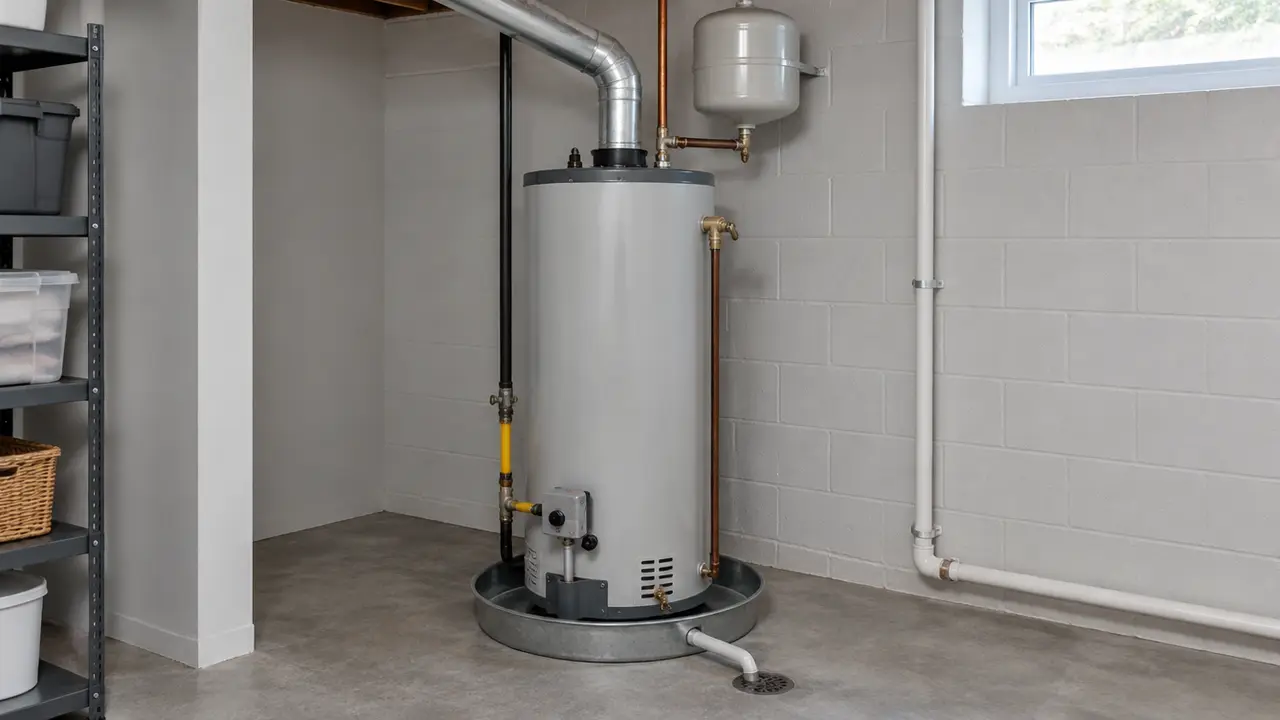
A conventional (atmospheric) gas water heater vents by buoyancy. The burner under the tank heats the flue gases, which rise through a central flue pipe inside the tank, past a twisted steel baffle that slows them so more heat reaches the water, and out the top into the draft hood. The draft hood is the open metal cone on top of the tank. It lets room air mix with the flue gases, which steadies the draft and cools the gases, and the mix rises up a vent connector into a chimney or metal B-vent and out of the house.
For that to work, three things have to be true. The flue gases must be warm enough to rise, the chimney or vent must be the right size and in good condition, and the house must let in as much air as it pushes out. Natural Resources Canada's Water Heater Guide describes conventional water heaters as using heated air from the house for combustion and dilution, air that enters through leaks in the building envelope. When any of the three fails, the draft weakens or reverses.
02 /What is backdrafting, and what is spillage?
Spillage is flue gas escaping from the draft hood into the room instead of going up the chimney. Backdrafting is the more severe case, where the chimney flow reverses and outdoor air comes down the vent, pushing combustion products into the house continuously. Natural Resources Canada defines spillage as the flow of combustion gases into the indoor air, notes it may occur when the burner first ignites before the upward flow is established, and calls it a serious problem.
The common causes are well known:
- House depressurization. Natural Resources Canada lists kitchen fans, bathroom fans, clothes dryers, central vacuums and fireplaces as devices that also need air and may pull air from the water heater flue. A powerful range hood in a tight house is a frequent culprit.
- A tight house. Energy-efficient, tightly sealed homes may not have enough natural leakage to supply combustion air and draft, according to the same guide.
- An orphaned water heater. When a furnace is upgraded to a condensing model with its own plastic vent, the water heater may be left alone on a chimney sized for two appliances. The small, cooler flow struggles to warm the large flue, draft stays weak and condensation forms.
- A blocked or damaged vent. Bird nests, collapsed masonry liners, disconnected or corroded connectors, and caps packed with ice.
- Cold starts. A cold chimney on a mild day, especially an exterior masonry chimney, can take longer to establish draft.
03 /What are the warning signs of a backdrafting water heater?
The clearest warning signs are heat and moisture damage around the draft hood, because that is where spilling gases escape. If you see any of these, have a licensed gas fitter check the venting.
| Sign | Where to look | What it suggests |
|---|---|---|
| Melted or deformed plastic | Plastic parts on top of the tank, the T&P valve handle, pipe insulation near the draft hood | Hot flue gas spilling from the draft hood |
| Scorching or discoloured metal | Top of the jacket around the draft hood | Repeated spillage |
| Soot or rust streaks | Draft hood rim, vent connector joints | Poor combustion or condensation in the vent |
| Water dripping from the vent or draft hood | Vent connector seams, top of tank | Condensation in an oversized or cold chimney |
| Stuffy, humid air or a sharp smell when the burner runs | Mechanical room | Combustion products entering the room |
| Pilot or burner going out repeatedly | Burner area | Downdraft or restricted air |
| CO alarm sounding | Anywhere | Treat as an emergency |
04 /How can you check a water heater for spillage safely?
A simple worst-case check at the draft hood tells you whether a conventional water heater drafts properly under stress. It involves no tools beyond a smoke source and does not touch gas or venting parts. Stop at any sign of trouble and call a professional.
- Set up the worst case
Close exterior doors and windows and the fireplace damper. Turn on every exhaust fan, the range hood on high and the clothes dryer.
- Make the heater fire
Run a hot tap until you hear or see the burner come on.
- Wait a couple of minutes
Give the chimney time to warm. Brief spillage in the first moments can happen as draft establishes.
- Test the draft hood
Hold a smoking incense stick or a lit match just blown out near the rim of the draft hood. The smoke should be pulled steadily into the hood.
- Read the result
If smoke drifts away from the hood or blows out, the heater is spilling. Turn off the exhaust devices, ventilate the room, and book a licensed gas fitter to check the venting and combustion air.
This check cannot find carbon monoxide produced by a poorly adjusted burner or a leak in a vent inside a wall, which is why a certified CO alarm still matters. The Water Heater Troubleshooter lists the stop-and-call triggers for gas smells, scorching and CO alarms.
05 /How do you fix a water heater that backdrafts?
The fix depends on the cause, and most involve a licensed gas fitter and a permit. These are the usual options, from simplest to most involved:
| Cause | Typical fix |
|---|---|
| Loose, disconnected or poorly sloped vent connector | Reconnect, secure every joint, correct slope and clearances |
| Blocked chimney or cap | Clear the blockage; install or repair the cap |
| Orphaned heater on an oversized chimney | Install a correctly sized chimney liner, or switch to a power vent or direct vent heater |
| House depressurization from exhaust devices | Provide makeup or combustion air as designed by a professional; reduce oversized exhaust |
| Tight house, recurring spillage | Replace with a sealed-combustion (direct vent) or power vent heater, or an electric or heat pump heater |
| Deteriorated masonry chimney | Reline or abandon the chimney and vent the heater another way |
Natural Resources Canada's Water Heater Guide is direct about the last two cases: if you have a newer house or have significantly reduced air leakage, you should consider a power-vented or sealed combustion water heater to eliminate the possibility of spillage and backdrafting. It also warns that an evaluation by qualified service personnel is required when adding, removing or replacing gas-fired equipment, since resizing or lining the chimney may be needed to avoid spillage and condensation. The power vent vs direct vent guide compares those replacements.
06 /Can power vent and direct vent heaters backdraft too?
They are far more resistant, but they can still put exhaust where it should not go when their vents are damaged or blocked. A power vent's fan pushes exhaust out under pressure, so a cracked or separated plastic vent joint indoors can leak flue gas into the room. And in Canadian winters the terminations themselves are the weak point.
Ontario's Technical Standards and Safety Authority (TSSA) warns that exhaust vents often exit the side of a home as low as about one foot (30 cm) above ground, can be buried by snow without the homeowner knowing, and that blocked exhaust vents can let carbon monoxide build up in the home. It advises clearing snow gently with a brush or broom and not scraping vents with sharp tools. Most power vent heaters shut down when a pressure switch senses a blocked vent, but do not rely on that alone; see power vent water heaters in winter.
07 /Where should carbon monoxide alarms go?
Put certified CO alarms near every sleeping area and, ideally, on every storey. Ontario's Fire Code requires CO alarms in homes with a fuel-burning appliance, adjacent to each sleeping area and, from January 1, 2026, on every storey. Health Canada notes carbon monoxide is produced whenever fuel such as natural gas or propane is burned, lists hot water tanks among household sources, and says it can only be detected with a CO alarm. Test alarms monthly and replace them at the end of the life printed on the unit.
If your checks raise doubts about venting, request a combustion and venting assessment along with any replacement quote through the quote page.
FAQQuestions people ask
Can a water heater leak carbon monoxide?
A gas or propane water heater produces carbon monoxide as part of combustion. It becomes dangerous when venting fails, through spillage, backdrafting, a blocked or disconnected vent, or poor combustion. A certified CO alarm is the only way to detect it.
Can a bathroom fan cause a water heater to backdraft?
On its own a bathroom fan rarely does, but combined with a range hood, dryer and a tight house it can contribute to depressurization. Natural Resources Canada lists bathroom fans among devices that may pull air from a water heater flue.
Why is water dripping from my water heater vent?
Usually condensation: the flue gases are cooling below their dew point in a cold or oversized chimney, often after a furnace was moved to its own vent. It needs a professional venting assessment.
Is it safe to have a gas water heater in an airtight house?
A conventional atmospheric heater can struggle for draft in a very tight house. Natural Resources Canada suggests a power vented or sealed combustion heater in newer or heavily air-sealed homes.
What does an orphaned water heater mean?
It is a water heater left alone on a chimney that used to serve both it and a furnace. The chimney may now be too large for the small heater, causing weak draft and condensation.