Tank Explorer is an interactive cutaway of a water heater. Choose a gas atmospheric, power-vent, electric, heat pump or tankless unit, drag the age slider from 0 to 15 years to watch sediment build and the anode wear away, and tap any hotspot to see what that part does, how it fails and what to do about it. The Heat it button animates how hot water layers inside a tank.
- Five modes: gas atmospheric, power vent, electric, heat pump and tankless, each drawn with the parts that type has.
- The age slider runs from 0 to 15 years; sediment height and anode depletion scale with age.
- Every hotspot gives three things: what the part does, how it fails, and what to do.
- The Heat it button animates stratification: hot water rising and settling in layers above cooler water.
- It is a teaching model, not a diagnosis of your tank; use the troubleshooter and lifespan predictor for decisions.
01 /What does Tank Explorer show?
Tank Explorer shows the inside of a water heater the way a service technician thinks about it: as a set of parts, each with one job and a known way of failing. Most people only ever see the steel jacket, a dial and a few pipes. The explorer strips the jacket away so you can see where cold water enters, how it reaches the bottom, where heat is added, how exhaust leaves, which parts protect the tank from bursting or rusting, and where sediment collects over the years.
It is built for three moments: when you want to understand the tank you already own, when a tradesperson has named a part you have never heard of, and when you are choosing between types and want to see what physically changes between a gas tank, a heat pump and a tankless unit. It does not measure or diagnose your own heater. For that, pair it with the Water Heater Troubleshooter and the Tank Lifespan Predictor.
02 /How do you use it?
- Pick a mode
Choose gas atmospheric, power vent, electric, heat pump or tankless. The cutaway redraws with the parts that type of heater has, so a burner and flue appear on gas units, elements on electric tanks, a compressor and evaporator on the heat pump, and a heat exchanger on the tankless unit.
- Set the age
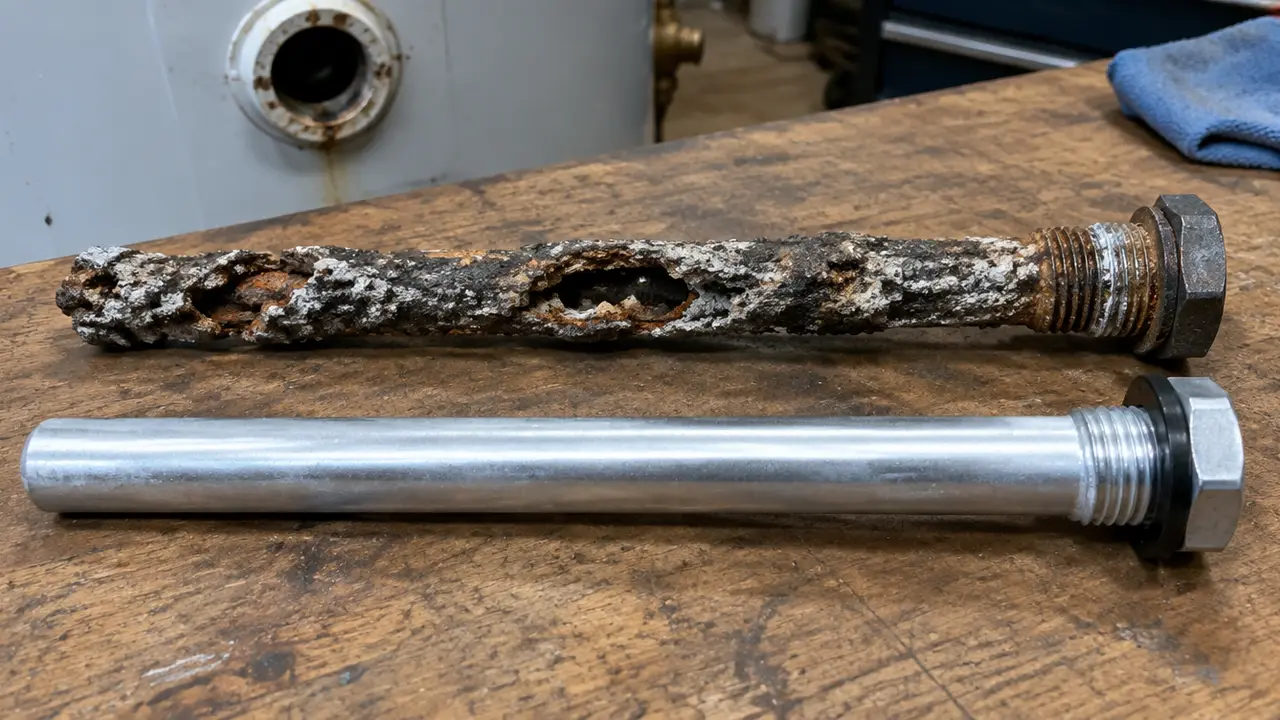
Drag the slider from 0 to 15 years. As age rises, the sediment layer on the tank floor gets taller and the anode rod gets thinner. At 0 years the anode is full length and the floor is clean; toward 15 years the anode is largely consumed and sediment is deep.
- Tap a hotspot
Each marker opens a card with three short parts: what it does, how it fails, and what to do. Read the cards for the parts nearest your symptom first.
- Press Heat it
The animation shows stratification: heated water rising to the top and settling in layers, with cooler water staying low. It explains why the top outlet delivers hot water while the bottom of the tank can be much cooler.
03 /The five modes, and what changes between them
Each mode is a different way of putting heat into water and getting rid of what is left over. The shell looks similar on four of the five, but the working parts are not.
| Mode | Heat source | Exhaust or by-product | Parts unique to this mode |
|---|---|---|---|
| Gas atmospheric | Gas burner under the tank | Hot flue gases rise through a central flue and a draft hood into a chimney or metal vent | Burner, pilot or igniter, flue and baffle, draft hood |
| Power vent | Gas burner under the tank | A fan pushes cooler exhaust through plastic vent pipe, usually out a side wall | Burner, igniter, flue and baffle, blower fan |
| Electric | Two resistance elements in the water | None: no combustion, no vent | Upper and lower heating elements with thermostats |
| Heat pump | A compressor moves heat from room air into the tank, with elements as backup | Cool, drier air and condensate water | Compressor, evaporator, fan, condensate drain |
| Tankless | Burner or elements fire only while water flows | Vented exhaust on gas units; none on electric | Heat exchanger, flow sensor |
Seeing the modes side by side answers several questions people search for. A power-vent heater is still a gas heater; the fan only changes how the exhaust leaves. A heat pump water heater is a tank, not a tankless unit. A tankless unit has no stored water to go cold overnight, but it has a heat exchanger that scales up in hard water. The full comparison is in types of water heaters.
04 /Every hotspot: what it does, how it fails, what to do
These are the 18 hotspots in the explorer. Not every mode has every part; the cutaway only draws the parts that type of heater has. The cards in the tool carry the same three-part logic as this table.
| Hotspot | What it does | How it fails | What to do |
|---|---|---|---|
| Cold inlet | Brings mains water into the tank, usually through a shut-off valve on the cold pipe above it. | The valve seizes or weeps at the stem; fittings corrode where dissimilar metals meet. | Find it now and label it. Closing it is your first move in any leak. |
| Dip tube | Carries incoming cold water to the bottom so it does not mix with hot water at the top. | Cracks or breaks up; cold water short-circuits to the outlet and hot water runs out fast. Plastic flecks may appear in aerators. | Suspect it when a newer tank delivers lukewarm water quickly. A pro can replace it with the water off. |
| Anode rod | A sacrificial magnesium or aluminum rod that corrodes so the steel tank does not. | It is consumed down to its core wire; then the tank itself starts to rust. Magnesium can feed a rotten-egg smell in some water. | Have it inspected every few years, sooner with softened or hard water. See anode rods. |
| Hot outlet | Carries hot water from the top of the tank to the house, often through heat-trap fittings. | Fittings corrode and drip onto the tank top. | Dry the top and watch where drips start: a fitting is repairable, the tank body is not. |
| T&P valve | Opens to release water if tank temperature or pressure climbs too high. | Weeps from debris on its seat or from high house pressure; can seize if never serviced. | Never cap or plug it. Find out why it discharged. See T&P valve dripping. |
| Discharge pipe | Carries anything the T&P valve releases down toward the floor or a drain. | Missing, undersized, capped, threaded at the end or run uphill: all make the valve less safe. | It should be full size with an open, visible end near the floor or a drain; your inspector sets the exact rule. |
| Gas control or thermostat | Sets the water temperature and, on gas units, controls the pilot and main burner with a safety shut-off. | Thermostats drift or fail; electric high-limit switches trip; gas valves can fail closed. | Do not open a gas valve. On electric tanks, cut power at the breaker before removing any cover. |
| Burner | The ring of flame under a gas tank that heats the water from below. | Lint or dust starves it of air; the flame turns yellow and sooty; rust from the flue can fall onto it. | A steady blue flame is normal. Yellow flame, soot or scorch marks: turn it off and call a gas fitter. |
| Pilot or igniter | A small standing flame, or an electronic igniter, lights the main burner. | A dirty pilot, a weak thermocouple or a tripped flammable-vapour sensor stops it staying lit. | Relight only by the label instructions. If it keeps going out, see pilot light won't stay lit. |
| Flue and baffle | A tube through the middle of a gas tank carries exhaust up; a twisted baffle slows it so more heat reaches the water. | Soot or scale blocks it; the baffle corrodes and heat transfer drops. | Sooting and scaling are service jobs, often a sign of a combustion or venting problem. |
| Draft hood or fan | On atmospheric tanks the draft hood steadies the draft into the chimney; on power-vent tanks a fan pushes exhaust out. | Atmospheric tanks can spill exhaust back into the room; fans wear, get noisy or trip on a blocked vent. | Keep vent terminals clear of snow and frost. Any spillage or CO alarm: get out and call. See venting and backdraft. |
| Drain valve | A tap near the bottom used to flush sediment and drain the tank. | Plastic valves drip or clog with sediment after a flush. | Cap it with a hose cap. See how to flush a hot water tank. |
| Insulation | Foam between the steel tank and the outer jacket slows standby heat loss. | It rarely fails, but gaps and damaged jackets waste heat. | Never wrap over gas controls, air openings or the top of a gas tank. |
| Sediment | Minerals and scale that settle out of heated water onto the tank floor. | On gas tanks it overheats the bottom and rumbles; on electric tanks it buries the lower element. | Flush as the manufacturer recommends. See rumbling and popping. |
| Heating elements | Electric rods inside the tank, usually an upper and a lower, each with its own thermostat. | They burn out, especially if energized with no water around them; scale shortens their life. | Breaker off before touching anything. Lukewarm or no hot water often means a failed element. |
| Compressor and evaporator | On a heat pump unit they pull heat out of the surrounding air and move it into the water. | A clogged air filter, a cramped or cold room, or a blocked condensate line cuts output. | Clean the filter, keep the clearances on the label, and keep the condensate drain open. |
| Heat exchanger | In a tankless unit, where burner or element heat passes into water as it flows through. | Scale builds up in hard water, causing error codes, temperature swings and low flow. | Descale on the maker's schedule; service valves make it far easier. See tankless maintenance. |
| Expansion tank | A small tank on the cold line with an air cushion that absorbs water expanding as it heats. | The internal bladder fails and the tank waterlogs; the T&P valve may then drip. | Needed where a check valve or pressure-reducing valve closes the system. See expansion tanks. |
05 /What the age slider teaches
The age slider links two slow processes to time. Sediment height and anode depletion both scale with age in the model, so you can see why an old tank behaves differently from a new one. The drawing is illustrative: real tanks age faster or slower depending on water chemistry, temperature setting, how much hot water you use and whether anyone has flushed the tank or replaced its anode.
Slide from 0 to about 5 years and the anode is still substantial while a thin sediment layer forms. By the middle of the range the anode is noticeably thinner and sediment covers the floor. Toward 15 years the anode is largely gone and the sediment layer is deep. That is the stage at which a gas tank starts to rumble, an electric tank's lower element struggles, and rust can appear in the hot water. The Tank Lifespan Predictor turns that same idea into a planning band for your actual tank.
06 /Why the Heat it button matters
Hot water is less dense than cold water, so it rises. A tank heated from the bottom, as a gas tank is, mixes quite well while the burner runs. An electric tank heated by elements partway up can leave a cooler zone below the lower element. The National Research Council notes that storing water below 60 °C in electric storage tanks may allow Legionella to grow because of this stratification, which is why the National Plumbing Code 2015 requires electric storage-type water heaters to be set at 60 °C.
The animation also explains everyday behaviour. When you run a shower, cold water enters at the bottom through the dip tube and pushes the hot layer out of the top. You get steady hot water until the hot layer is used up, then the temperature falls quickly. A broken dip tube breaks that pattern, which is why it shows up as hot water that runs out far too soon.
07 /Limits of the model
- It is a generic cutaway. Your tank's layout, part names and access panels may differ; the rating plate and manual are the authority for your model.
- The age slider is illustrative. It does not know your water hardness, flushing history or anode history.
- Hotspot advice is general. Anything involving gas, venting, combustion or opening an electric panel belongs with a licensed trade.
- It does not size, price or rank heaters, and it never names brands.
When you are ready to act, the troubleshooter ranks causes for a symptom, the size calculator sizes a replacement, and the energy cost comparer prices running costs with your own rates. If you need a tradesperson, you can request quotes and describe what you saw in the explorer.
FAQQuestions people ask
What is a dip tube and why does it matter?
It is a plastic tube that carries incoming cold water to the bottom of the tank. If it breaks, cold water mixes with the hot water at the top and hot water runs out much sooner than it should.
Is a heat pump water heater tankless?
No. A heat pump water heater stores water in a tank like an electric tank, but heats it mostly with a compressor that pulls heat from room air. Tankless units heat water only as it flows.
Where is the anode rod on a hot water tank?
Usually it is screwed into the top of the tank under a cap or plug, and on some models it is combined with the hot outlet fitting. The manual shows its location for your model.
Why does my gas water heater have a flue through the middle?
Hot exhaust from the burner rises through a central flue, and a baffle inside slows it so more heat passes into the water before the gases leave through the vent.
Does the age slider tell me how old my tank is?
No. It shows how sediment and anode wear typically progress with age. Find your tank's age from the serial number or rating plate, then use the Tank Lifespan Predictor.