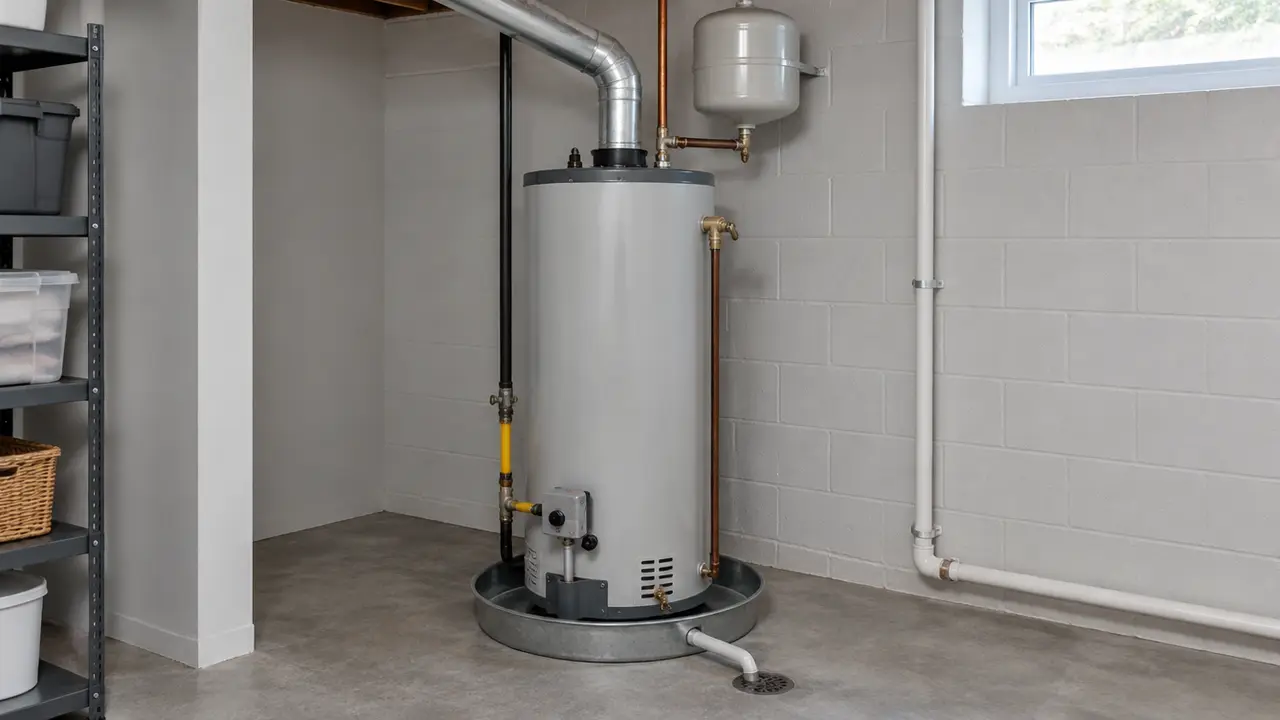
A thermal expansion tank gives heated water somewhere to go. Water heated from 10 °C to 60 °C grows by about 1.7%, roughly 3 litres in a 50-gallon tank. In a closed system, where a check valve, backflow preventer or pressure-reducing valve stops water flowing back to the main, that growth spikes pressure and makes the T&P valve drip. The tank's air cushion absorbs it.
- Water expands as it heats: about 3.2 L when a 189 L tank goes from 10 °C to 60 °C.
- The National Plumbing Code requires protection against thermal expansion where check valves, backflow preventers or pressure-reducing valves are installed.
- Acceptable means include a diaphragm expansion tank rated for potable water or a thermal expansion relief valve set at 550 kPa or less.
- The tank's air pre-charge must be set to your static water pressure before it is installed, or it will not absorb expansion properly.
- A waterlogged expansion tank feels heavy and sounds solid when tapped; a dripping T&P valve after heating cycles is a common symptom.
01 /What does an expansion tank do?
An expansion tank absorbs the extra volume water takes up as it heats, so pressure in the plumbing stays steady. Water is almost incompressible and gets less dense as it warms. Heating the 189 litres in a 50-gallon tank from 10 °C to 60 °C increases its volume by about 1.7%, roughly 3.2 litres. That water has to go somewhere.
In an open system it simply pushes back through the cold supply pipe into the city main. In a closed system it cannot, so the pressure in every pipe, fitting, faucet cartridge and the tank itself climbs with each heating cycle until something gives: the T&P valve lifts and drips, a toilet fill valve weeps, or fittings are stressed over years.
A diaphragm expansion tank is a small steel tank split in two by a flexible diaphragm or bladder. One side is connected to the cold water line; the other holds air or nitrogen pre-charged to about the same pressure as your water supply. When the water heater fires and water expands, it pushes into the tank and compresses the air cushion slightly. When hot water is used and cold refills the heater, the air pushes the water back out.
02 /When is an expansion tank required?
An expansion tank or other protection is required when your water system is closed and thermal expansion can occur. The 2025 edition of the National Plumbing Code of Canada (Article 2.6.1.11) says that where thermal expansion can occur, protection shall be provided for check valves required by the code, backflow preventers required by the code, and pressure-reducing valves required by the code. Similar wording appears in earlier editions. Your province's adopted edition governs.
| Device | Why it is there | Effect on expansion |
|---|---|---|
| Check valve at the building end of the water service | The NPC requires one where the service pipe is plastic suitable for cold water only | Stops expanding water returning to the main |
| Backflow preventer | Required by some utilities or for certain connections, such as irrigation or boilers | Blocks reverse flow |
| Pressure-reducing valve (PRV) | The NPC requires one where static pressure at a fixture may exceed 550 kPa (about 80 psi) | Many PRVs do not pass water backwards |
| Water meter with an internal check | Some utility meters include one | Can close the system; ask your utility |
The code's explanatory note lists three acceptable ways to accommodate the pressure increase in a closed system: a suitably sized diaphragm expansion tank designed for potable water; an auxiliary thermal expansion relief (T.E.R.) valve conforming to CSA B125.3, set at 550 kPa or less and designed for repeated use; or other means acceptable to the authority having jurisdiction. In practice most homes get an expansion tank, because it protects without discharging water.
03 /How do you know if you need an expansion tank?
Measure it. A pressure gauge that screws onto a laundry tap or hose bib, ideally one with a red drag needle that records the maximum, tells you in a day whether thermal expansion is a problem.
- Read static pressure
With no water running, note the pressure. This is also the figure the expansion tank's pre-charge should match.
- Leave the gauge on through a heating cycle
Run a shower long enough for the water heater to fire, stop all use and let the burner or elements finish.
- Check the peak
If pressure climbs steadily while nothing runs and the drag needle shows a spike well above static, your system is closed and expanding.
- Look for the symptoms
A T&P valve that drips mostly after the heater has run, toilets that hiss briefly after heating cycles, or a hot tap that spurts on opening all point the same way.
If static pressure itself is high, above 550 kPa (about 80 psi), the fix starts with a PRV, which in turn makes an expansion tank necessary. A T&P valve dripping for other reasons, such as debris on the seat or an overheating thermostat, is covered in T&P valve dripping.
04 /What size expansion tank do you need?
Size the tank from the water heater volume, your static supply pressure and the maximum pressure you want the system to reach, using the expansion tank manufacturer's chart. Small residential expansion tanks are common for 40–60 gallon heaters at ordinary supply pressures, but higher pressure or larger heaters call for bigger tanks, and the chart is the authority.
The physics explains why pressure matters so much. The air cushion obeys Boyle's law: its pressure times its volume stays roughly constant. Suppose street pressure is 410 kPa (about 60 psi) and you want the peak to stay under 550 kPa. Converting to absolute pressure, the air can only shrink from 511 to 651 kPa, or about 21% of its volume. To swallow 3.2 litres of expansion, the cushion needs about 15 litres of air. Drop the supply pressure to 345 kPa (about 50 psi) and the same job needs only about 10 litres. The higher your starting pressure, the less work each litre of air can do.
| Factor | Effect on size needed |
|---|---|
| Larger water heater | More water expanding; bigger tank |
| Higher set temperature | More expansion per heating cycle; bigger tank |
| Higher static supply pressure | Air cushion already compressed; bigger tank |
| Lower allowed peak pressure | Less room for the air to compress; bigger tank |
05 /How should an expansion tank be installed?
An expansion tank goes on the cold water supply between the closing device (check valve, backflow preventer or PRV) and the water heater, usually on the cold line close to the heater. Follow the manufacturer's instructions, which commonly cover:
- Potable rating. Use a tank designed for potable water, not a heating-system (boiler) expansion tank.
- Location. On the cold side, with no shut-off valve that could isolate the heater from the tank while the heater can still fire.
- Orientation. Many manufacturers allow vertical or horizontal mounting; some specify the connection up or down. Check the instructions rather than assuming.
- Support. A tank full of water is heavy. Strap or bracket it to structure; do not hang it from a thin copper line.
- Pre-charge. Set to static pressure before filling, as above.
Tankless and heat pump systems raise their own questions. A tankless unit holds very little water, so expansion is small, but a closed system can still see pressure rises from other connected storage. Follow the manufacturer's guidance and your inspector. For a sense of where the tank sits in a full installation, see the installation guide.
06 /How do you tell if an expansion tank has failed?
A failed expansion tank is usually waterlogged: the diaphragm has ruptured or the air charge has leaked away, so the tank is full of water and absorbs nothing. Signs include:
- The tank feels heavy and sounds solid when tapped all over; a healthy tank sounds hollow on the air side.
- Pressing the air valve pin releases water instead of air, which means the diaphragm has failed.
- The T&P valve starts dripping again after heating cycles, or pressure spikes return on your gauge.
- Rust or weeping at the tank's seams or connection.
A tank that has only lost air can sometimes be recharged by isolating it and adding air. A tank with a ruptured diaphragm has to be replaced. Many owners replace the expansion tank whenever the water heater is replaced. Add both to your maintenance schedule.
| Job | Typical range |
|---|---|
| Add an expansion tank during a water heater install | $200–$500 |
| Add or replace an expansion tank as a separate service call | $300–$700 |
If you are replacing the water heater anyway, ask for expansion control in the same quote request.
FAQQuestions people ask
Does an expansion tank go on the hot or cold side?
Normally the cold side, between the check valve, backflow preventer or pressure-reducing valve and the water heater. Follow the manufacturer's instructions.
Can an expansion tank be installed horizontally or upside down?
Many can; manufacturers differ on allowed orientations and whether the connection should face up or down. The tank must also be properly supported. Check the installation instructions for your model.
Does an expansion tank help with water pressure or water hammer?
No for low pressure: it does not raise pressure. It limits pressure spikes caused by heating. Water hammer from fast-closing valves is a separate problem that the plumbing code addresses with water hammer arresters.
Is an expansion tank the same as a well pressure tank?
No. A well pressure tank stores water to reduce pump cycling. A thermal expansion tank is smaller and only absorbs expansion from heating. Their pre-charges and sizing differ.
What happens when an expansion tank is full of water?
It stops working. Pressure spikes return with each heating cycle, and the T&P valve may start dripping. The tank needs recharging or replacement.
Does a tankless water heater need an expansion tank?
Sometimes. It stores little water, but whether protection is needed depends on whether the system is closed and on the manufacturer's instructions and local inspector.