Canadian homes use nine main types of water heater: atmospheric gas tanks, power-vent gas tanks, direct-vent gas tanks, condensing gas tanks, electric tanks, heat pump (hybrid) tanks, tankless units (gas or electric), combination or indirect systems fed by a boiler, and solar-assisted systems. They differ in fuel, venting, efficiency, recovery speed, space needs and installed cost. Your fuel supply and venting path usually narrow the choice to two or three.
- Atmospheric gas tanks are the simplest gas option but need a working chimney or metal vent and are the least efficient.
- Power-vent and direct-vent tanks vent through a wall; power vents need electricity and are common where the chimney no longer works for a tank alone.
- Heat pump water heaters are electric tanks with a compressor; NRCan says ENERGY STAR models use up to 70% less energy than a standard electric tank.
- Tankless units heat on demand; sizing is about flow and temperature rise, and cold Canadian inlet water raises the power needed.
- Combi and indirect systems use a boiler or combination appliance to heat both the house and the water.
01 /What are the main types of water heaters?
Every water heater does one of three things: it stores heated water in a tank, it heats water only as it flows, or it borrows heat from another system. Within those three families, the fuel and the venting decide most of the practical differences. The table gives the overview; the sections below explain each type and who it suits.
| Type | Energy | Venting | Representative UEF | Planning life | Best fit |
|---|---|---|---|---|---|
| Atmospheric gas tank | Natural gas or propane | Chimney or metal vent (natural draft) | 0.62 | 8–12 years | Homes with a sound, correctly sized chimney |
| Power-vent gas tank | Gas plus electricity for the fan | Fan-driven plastic vent through a wall | 0.66 | 8–12 years | No usable chimney; basement far from roof |
| Direct-vent gas tank | Gas | Sealed combustion through a wall | Similar to atmospheric or power vent | 8–12 years | Tight homes, rooms with no spare combustion air |
| Condensing gas tank | Gas plus electricity | Plastic vent; condensate drain | 0.85 | Varies by model | High use, gas homes wanting efficiency |
| Electric tank | Electricity (240 V) | None | 0.92 | 10–15 years | No gas; simple installs; low use |
| Heat pump tank | Electricity | None (some ducted); condensate drain | 3.0 (lower in cold rooms) | 10–15 years | Electric homes; basements with space |
| Tankless (gas) | Gas plus electricity | Sealed plastic or stainless vent | 0.93 (condensing) | 15–20 years | Space-limited homes; long showers |
| Tankless (electric) | Electricity, very high amperage | None | Near 1 | Varies | Point-of-use; small suites |
| Combi or indirect | Boiler or combination appliance | Via the boiler | Depends on the boiler | Varies | Homes with hydronic heating |
The UEF values and life ranges are the representative figures used by the Energy Cost Comparer and the Tank Lifespan Predictor, not ratings for particular models. Real models vary; check the rating plate and specification sheet.
02 /Atmospheric (natural draft) gas tanks
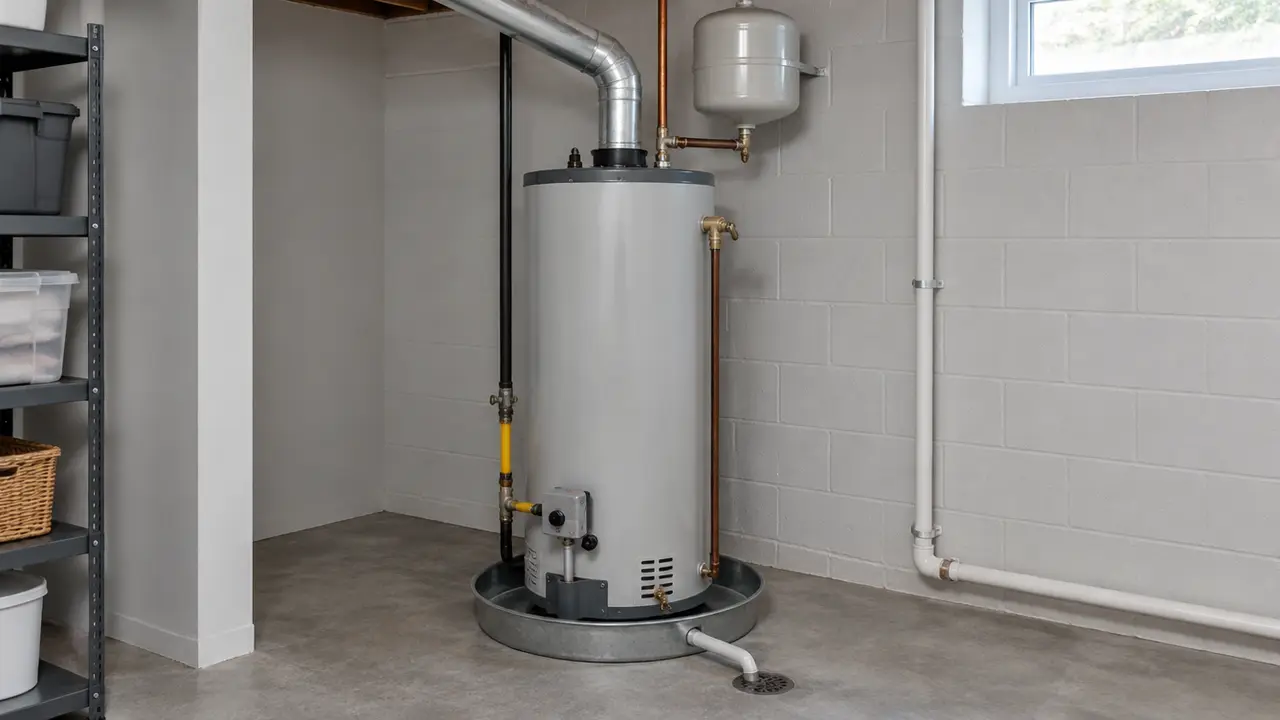
An atmospheric tank is the classic Canadian basement water heater: a gas burner under the tank, a flue up the middle, and a draft hood on top connected to a chimney or a metal B-vent. Nothing pushes the exhaust; hot gases rise on their own. That makes it simple and, with a standing pilot and a thermopile-powered control, able to keep heating in a power outage.
The weaknesses come from the same design. Some heat escapes up the chimney, and warm room air keeps drifting up the flue when the burner is off, which is why representative efficiency is the lowest of the gas options. The draft is also fragile. A large kitchen exhaust fan, a clothes dryer or a tight house can pull air down the chimney and spill exhaust back into the room. A common Canadian case is the orphaned water heater: when a furnace is replaced with a high-efficiency model that vents through plastic pipe, the water heater may be left alone in a chimney sized for two appliances, which can draft poorly or form condensation. A gas fitter has to check it and may require a liner or a different type of heater.
03 /Power-vent and direct-vent gas tanks
A power-vent tank is a gas tank with a fan on top. The fan pushes cooled exhaust through plastic pipe, usually out a side wall, so no chimney is needed. It is the standard answer when a chimney is gone, unsafe or oversized, or when the tank is far from the roof. It needs a nearby electrical outlet and does not heat in a power outage. The fan makes some noise, and the wall terminal must be kept clear of snow and frost, which is a frequent winter cause of no hot water.
A direct-vent tank uses sealed combustion: it draws combustion air from outside and sends exhaust outside, often through a concentric pipe, without using room air. Some direct-vent tanks draft naturally and some use a fan (power direct vent). Sealed combustion is less prone to backdrafting, which is why Natural Resources Canada points to sealed combustion appliances using direct vent technology as a way to avoid combustion spillage.
Both types cost more to buy and install than an atmospheric tank. The power vent vs direct vent guide compares them in detail, and venting and backdraft explains the safety side.
04 /Condensing gas tanks
A condensing tank extracts extra heat from the exhaust by cooling it until the water vapour in it condenses, the same principle as a high-efficiency furnace. The exhaust is cool enough to vent through plastic pipe, and the acidic condensate needs a drain, sometimes with a neutralizer. They suit gas homes with high hot water use, where the efficiency gain is worth the higher price. With a representative UEF of 0.85 against 0.62 for an atmospheric tank, the same household buys roughly a quarter less gas.
05 /Electric tanks
An electric tank heats water with two resistance elements and needs no vent, no gas line and no combustion air. It is the simplest to install and has no carbon monoxide risk of its own. Nearly all the electricity becomes heat in the water; the loss is standby heat through the jacket. Its limits are slower recovery, so it needs a larger size for the same demand, and running cost, which in most provinces is higher than gas per unit of heat. Where electricity is cheap and clean, as in parts of Canada, an electric tank is often the default.
The National Plumbing Code 2015, as the National Research Council explains, requires electric storage-type water heaters to be set at 60 °C to limit Legionella growth, because stratification can leave the bottom of an electric tank cooler. Natural Resources Canada suggests an insulated base and an insulating kit for electric tanks in basements.
06 /Heat pump (hybrid) water heaters
A heat pump water heater is an electric storage tank with a small heat pump on top. Instead of making heat, the compressor moves heat from the surrounding air into the water, with ordinary elements as backup for heavy demand. Natural Resources Canada says an ENERGY STAR certified heat pump water heater is up to four times more efficient and uses up to 70% less energy, on average, than a standard electric water heater.
The catch is the air. The unit cools and dries the room it sits in, needs space around it and a drain for condensate, and makes some fan and compressor noise. It works best in a basement or utility room that stays reasonably warm; in a cold room it falls back on its elements more. In winter, the heat it takes from a heated basement is partly replaced by your space heating. The heat pump water heater guide covers placement and cold-climate performance.
07 /Tankless (on-demand) water heaters
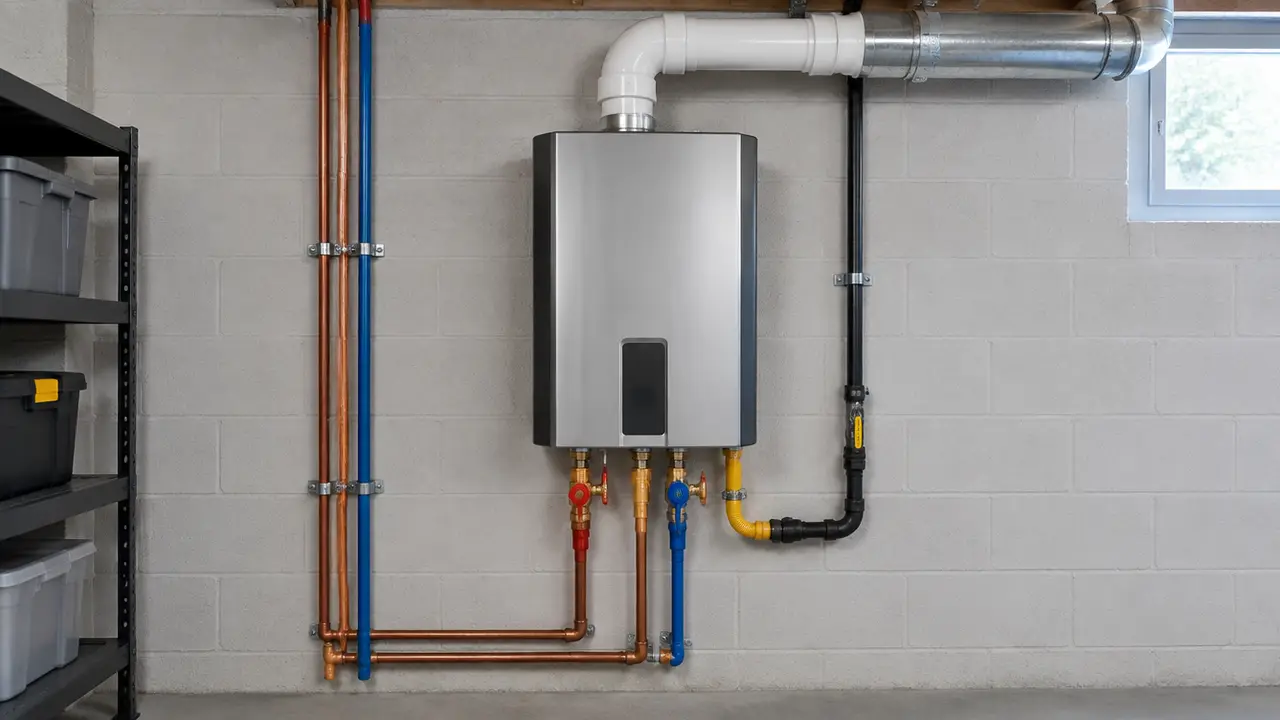
A tankless unit has no stored water. When a tap opens and flow passes a threshold, a burner or electric elements fire and heat the water as it moves through a heat exchanger. There are no standby losses and no tank to rust, it hangs on a wall, and it never runs out of hot water as long as the flow stays within its capacity.
Capacity is the key limit in Canada. The unit must raise every litre from winter inlet temperature to the delivered temperature in real time. Two showers at once from 7 °C water need about 44.5 kW, which is roughly 160,000 BTU/h of gas input, and far more current than most houses can supply for an electric model. Gas tankless units usually need a larger gas line and dedicated venting, and in hard water the heat exchanger needs regular descaling. See tankless vs tank and size one with the Water Heater Size Calculator.
08 /Combi, indirect and solar systems
A combination (combi) system heats both the house and the water from one appliance, commonly a combi boiler that heats water on demand or a boiler or water heater feeding a fan coil for forced air. An indirect water heater is a well-insulated tank with a coil inside, heated by a boiler that also serves the house's hydronic heating. Both make most sense in homes that already have a boiler. See combi and indirect water heaters.
Solar water heating preheats water with roof collectors and relies on a conventional heater as backup. NRCan's guide notes that solar systems typically generate about 60% of hot water needs depending on climate. Recirculation pumps are not a type of heater but are often added to any of them to bring hot water to distant taps faster; see recirculation pumps.
09 /How do you narrow it down? Five questions
- What fuel do you have?
No gas line rules out gas types unless you add one. Propane is an option in rural areas.
- How can it vent?
A sound, correctly sized chimney allows an atmospheric tank. No chimney, or an orphaned one, points to power vent, direct vent, condensing or electric options.
- What electrical capacity is there?
Heat pump tanks usually need a 240 V circuit; whole-house electric tankless can exceed a home's entire service.
- What is the space like?
Heat pumps need room, air volume and a drain; tankless units need wall space and venting; tanks need floor space and a drain pan.
- What is your peak demand?
Size by first-hour rating for tanks or by flow for tankless, using the size calculator.
Then compare running costs with your own prices in the Energy Cost Comparer, installed prices in the replacement cost guide, and work through the choosing a water heater checklist. HotWaterTank.ca does not rank brands or sell heaters; when you are ready, you can request quotes.
FAQQuestions people ask
What is the most common type of water heater in Canada?
Storage tanks, gas or electric, are the most common. Natural Resources Canada describes the gas storage tank as the most common type in Canadian homes; electric tanks are common where gas is not available.
Is a power vent water heater gas or electric?
Gas. A power-vent heater burns natural gas or propane like any gas tank, and uses a small electric fan to push the exhaust out through plastic pipe.
Is a heat pump water heater gas or electric?
Electric. It uses a compressor to move heat from the surrounding air into a storage tank, with electric elements as backup.
What is the most efficient type of water heater?
Heat pump water heaters have the highest efficiency ratings because they move heat rather than make it. Among gas options, condensing tankless and condensing tanks are most efficient.
What is an orphaned water heater?
A gas water heater left alone in a chimney after the furnace that shared it was replaced with a high-efficiency, plastic-vented model. The chimney may now be too large for good draft and must be checked.
Can a heat pump water heater be installed in a closet?
Only if the manufacturer's clearance and air-volume requirements are met, sometimes with louvred doors or ducting. Small closed closets usually starve it of air.