A tank stores about 150 to 285 litres of hot water and can feed several fixtures at once until the store runs down. A tankless unit heats water as it flows, so it never runs out of volume, but its flow is capped by how much heat it can add to cold winter inlet water. Tankless saves standby energy and space; a tank costs less to install.
- A tank is limited by its first-hour rating; a tankless unit is limited by flow rate and the temperature rise it must deliver.
- Winter inlet water in Canada can fall to about 5 °C, which cuts a tankless unit's hot water flow sharply compared with summer.
- Two showers at once from 7 °C water need about 44.5 kW of heat: roughly 160,000 BTU/h of gas input, or about 186 A at 240 V electric.
- Gas tankless units usually need a larger gas line, new sidewall venting and a condensate drain; they also need household power to run.
- Tankless wins on efficiency, space and service life; a tank wins on purchase price, simultaneous-use comfort and simplicity.
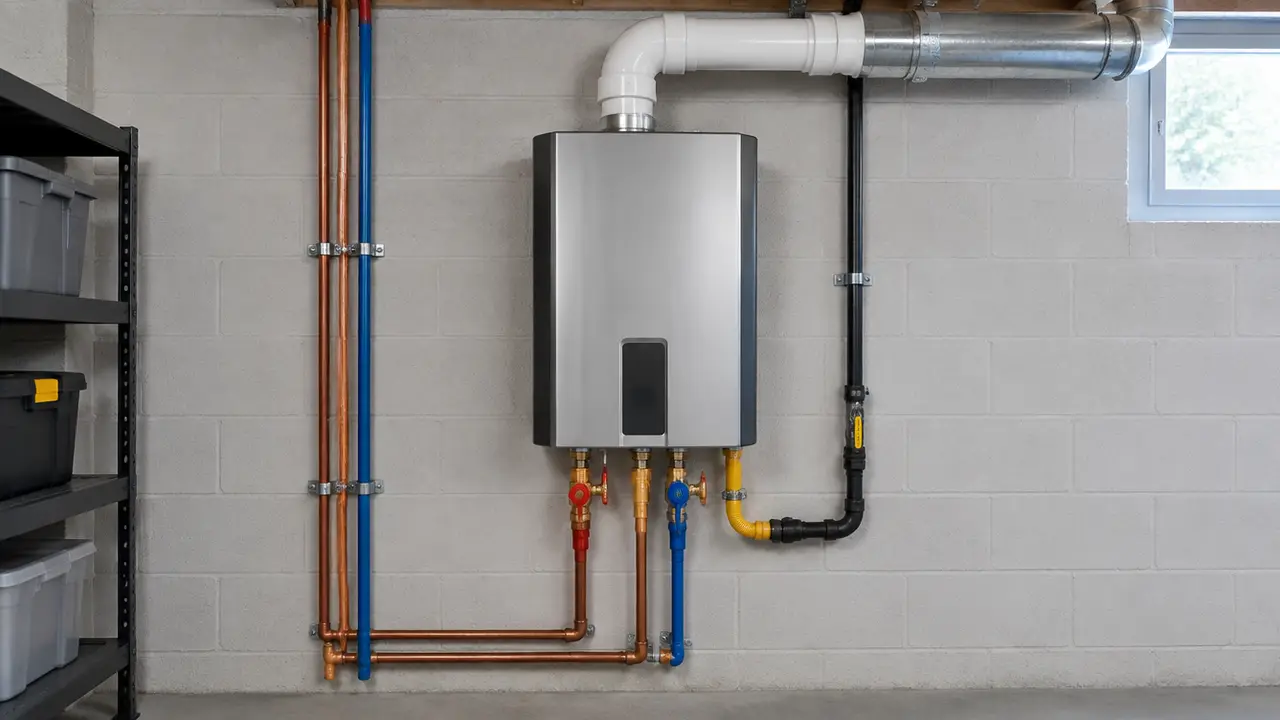
01 /How do tank and tankless water heaters actually differ?
A tank water heater is a battery of heat: it keeps a store of water hot and ready, then reheats the store after you draw it down. A tankless (on-demand) water heater keeps nothing in reserve. When a tap opens and water starts to flow, a flow sensor fires a burner or switches on electric elements, and a heat exchanger raises the passing water to the set temperature in a few seconds. That single difference drives almost every other trade-off between the two.
Because a tank is a store, its limit is volume over time. Natural Resources Canada's Water Heater Guide describes the relevant rating as the first-hour rating (FHR): the litres of hot water a full, fully heated tank can deliver in one hour. Because a tankless unit is a flow device, its limit is power: how many litres per minute it can heat by a given number of degrees. You size a tank for your busiest hour and a tankless unit for your busiest minute.
If you want to see both designs from the inside before deciding, open the Tank Explorer and switch between the gas, electric, heat pump and tankless modes. The types of water heaters guide covers the wider family, including heat pump and combination systems.
02 /Why does winter inlet water matter so much for tankless?
Winter inlet water matters because a tankless unit's output is fixed in kilowatts, and the colder the incoming water, the fewer litres per minute those kilowatts can heat. The physics is simple: heating one litre of water by one degree Celsius takes about 4.186 kilojoules. Divide the unit's heat output by the temperature rise and you get the flow it can sustain.
Natural Resources Canada gives a worked example in its Water Heater Guide: a unit that delivers 15 litres per minute at 58 °C with 18 °C summer inlet water can deliver only about 11 litres per minute when the inlet falls to 5 °C. Canadian municipal water commonly arrives far colder in February than in August, which is why a tankless unit that felt limitless in September can struggle with two showers in January.
| Fixtures running together | Flow (L/min) | Heat needed (kW) | Gas input at 95% efficiency (BTU/h) | Electric current at 240 V (A) |
|---|---|---|---|---|
| One shower | 7.6 | 22.3 | about 80,000 | about 93 |
| Shower plus kitchen sink | 13.3 | 39.0 | about 140,000 | about 162 |
| Two showers | 15.2 | 44.5 | about 160,000 | about 186 |
| Two showers plus a sink | 20.9 | 61.2 | about 220,000 | about 255 |
Two lessons fall out of that table. First, gas tankless units for whole houses in Canada are typically in the upper end of the residential input range, because two simultaneous showers in winter already call for about 160,000 BTU/h. Second, whole-house electric tankless is rarely practical here: a load of 186 amps for two showers is close to or beyond the entire service of many homes, which are commonly 100 or 200 amps. Electric tankless units make more sense as small point-of-use heaters under a distant sink.
03 /Can a tankless water heater run out of hot water?
A tankless water heater cannot run out of hot water in the way a tank does, because it never depletes a store. It can, however, run out of temperature. When the combined flow exceeds what the burner can heat through the winter temperature rise, the unit either delivers cooler water or, on many models, limits the flow to hold temperature. Either way, the second shower feels it.
Three smaller quirks are worth knowing before you buy:
- Minimum flow to fire. A tankless unit needs a minimum flow before it lights. A thin trickle for shaving or rinsing may not trigger it, so you get cold water at a very low flow.
- The cold-water sandwich. If you shut a tap and reopen it a minute later, water sitting in the pipes is still hot, then a slug of cold passes through before the burner catches up. Some models include a small buffer tank or internal recirculation to smooth this.
- Wait time is the same or longer. Tankless does not bring hot water to a far bathroom faster than a tank does. The pipe between heater and tap still has to empty first. The recirculation pumps guide explains the fixes.
A tank has the opposite personality. It will happily run a shower, the dishwasher and a laundry load together at full pressure, but after a long run of showers it goes lukewarm and needs time to recover. If your household's problem is running out late in the morning, compare a larger tank and a tankless unit on the numbers in the what size water heater guide before assuming tankless is the only fix.
04 /Is a tankless water heater more efficient than a tank?
Yes, a gas tankless unit is usually more efficient than a standard gas tank, mainly because it has almost no standby loss and most whole-house models condense their exhaust to recover extra heat. In Canada the federal Energy Efficiency Regulations already set a minimum uniform energy factor (UEF) of 0.86 or 0.87 for household gas-fired instantaneous water heaters, depending on flow rate, for units manufactured from January 1, 2020, as published by Natural Resources Canada when checked in September 2026. A standard atmospheric gas tank sits far lower.
Natural Resources Canada's guide to residential water heaters states that an ENERGY STAR certified tankless water heater can save about 30% more energy than a standard storage tank. The size of that saving in dollars depends entirely on your gas price and how much hot water you use.
| Technology | Representative UEF | Gas used per year | Example energy cost per year |
|---|---|---|---|
| Atmospheric gas tank | 0.62 | about 28.4 GJ | about $227 |
| Power-vent gas tank | 0.66 | about 26.7 GJ | about $213 |
| Condensing gas tank | 0.85 | about 20.7 GJ | about $166 |
| Condensing gas tankless | 0.93 | about 18.9 GJ | about $151 |
The example uses the Energy Cost Comparer formula with an example commodity price of $8 per gigajoule. Many Canadian gas bills add delivery and fixed charges that make the effective price per gigajoule higher, so enter your own all-in rate. On these numbers the tankless unit saves about $76 a year against a standard tank; at a higher effective gas price the saving grows in proportion. That saving has to pay back a higher installed price, which is why the decision is rarely made on efficiency alone.
05 /What does a tankless installation need that a tank does not?
A gas tankless installation usually needs a bigger gas supply, new venting, a condensate drain, an electrical outlet and sometimes water treatment. These are what push its installed price above a like-for-like tank swap.
- Gas line capacity
Natural Resources Canada's Water Heater Guide notes that a gas tankless heater will typically require a 3/4-inch (1.9 cm) supply compared with a 1/2-inch (1.2 cm) supply for a standard water heater. The gas meter and the whole run back to it must also carry the combined load of the furnace, range and the new unit at once.
- Venting
Condensing tankless units vent through a sidewall or roof in plastic pipe, and their exhaust is cool enough to form condensate. The old chimney is no longer used. Termination clearances from windows, doors, the gas meter and grade come from the gas installation code and the manufacturer's instructions.
- Condensate drain
Condensing units produce acidic condensate that must drain to a floor drain or pump, often through a neutralizer. In a cold room or crawlspace that line must be protected from freezing.
- Electricity
The fan, controls and ignition run on a standard 120 V circuit, so a gas tankless unit makes no hot water in a power outage.
- Water quality
Hard water deposits scale inside the small heat exchanger passages. Plan on periodic descaling through service valves, and consider softening where water is very hard; the tankless maintenance guide walks through descaling step by step.
An electric tankless unit swaps the gas and venting items for heavy electrical work: large breakers, heavy conductors and possibly a service upgrade. Because of the currents shown earlier, most Canadian households use electric tankless only at a single remote fixture.
06 /How do the costs compare over the life of the heater?
A tank costs less on day one and a tankless unit usually costs less per year to run and lasts longer, so the lifetime comparison depends on how long you stay, your gas price and whether the tankless install needs a gas line upgrade. The planning ranges below are editorial estimates for a typical detached house; the hot water tank replacement cost page breaks the tank side down further.
| Option | Typical installed range | Main cost drivers |
|---|---|---|
| Atmospheric gas tank, like-for-like | $2,000–$3,500 | Size, chimney condition, permit, haul-away |
| Power-vent gas tank | $3,000–$5,000 | New sidewall vent, electrical outlet, fan unit |
| Condensing gas tankless | $4,500–$8,000 | Gas line upsizing, venting, condensate drain, wall mounting |
| Electric tankless, point-of-use | $800–$2,000 | Breaker and wiring from the panel |
Using the representative life ranges from the Tank Lifespan Predictor, a gas tank lasts roughly 8 to 12 years and a tankless unit 15 to 20. Over 20 years that can mean buying two tanks against one tankless unit, which narrows the up-front gap considerably. It does not erase it if the tankless unit needs a major gas line run, and descaling costs belong on the tankless side of the ledger.
07 /Which should you choose? Decision rules that hold up
| Your situation | Usually the better fit | Why |
|---|---|---|
| Tank failed today, budget tight, chimney in good shape | Like-for-like tank | Lowest cost, fastest install, no new venting |
| Two or more showers often run together in winter | Large tank or a high-input tankless unit sized for your inlet temperature | Simultaneous flow is where small tankless units fall short |
| Tight mechanical room, planning to stay 10+ years | Condensing tankless | Saves floor space and standby energy over a long life |
| Very hard water and no plan to descale | Tank | Scale shortens tankless life quickly without maintenance |
| Want hot water during power outages | Atmospheric gas tank | Many run without household power; tankless cannot |
| All-electric home or electrification goal | Heat pump water heater | Far cheaper to run than resistance tanks; see the heat pump guide |
If neither option feels obvious, run your household through the choosing a water heater checklist, then compare the specific options with the Energy Cost Comparer. When you are ready to price it, a quote request that names both options lets installers price the tankless gas line and venting work separately so you can see exactly where the difference comes from.
FAQQuestions people ask
Is a tankless water heater worth it in Canada?
It is worth it when you plan to stay long enough for lower energy use and longer life to repay the higher installed price, and when the unit is sized for your winter inlet temperature. It is rarely worth it as an emergency replacement where a new gas line and venting would have to be added in a hurry.
What size tankless water heater equals a 50-gallon tank?
Natural Resources Canada suggests multiplying a tankless unit's flow in gallons per minute by 60 to compare it with a tank's first-hour rating. Even a modest 10 L/min unit delivers 600 L in an hour, more than a typical 50-gallon gas tank's first-hour rating of about 310 L. The real question is simultaneous flow in winter: size for the fixtures you run together.
Does a tankless water heater work during a power outage?
No. Gas tankless units need household power for the fan, controls and ignition, and electric units need power to heat. Many standard atmospheric gas tanks with a standing pilot keep heating during an outage.
Do tankless water heaters need maintenance?
Yes. The heat exchanger should be descaled periodically, more often in hard water, and the inlet screen, condensate line and vent terminations should be checked. Skipping descaling is the most common reason a tankless unit fails early.
Does a tankless water heater need an expansion tank?
It stores very little water, so thermal expansion is small, but plumbing codes look at whether the system is closed by a check valve, backflow preventer or pressure-reducing valve. Follow the manufacturer's instructions and your local inspector; the expansion tanks guide explains the rule.