Size a tankless water heater for the fixtures you run at the same time and your coldest incoming water. Add their flows in litres per minute, multiply by the rise from winter inlet water to 49 °C and by 4.186, and divide by 60 to get kilowatts. Gas input in BTU/h is kW × 3,412 ÷ 0.95. Two showers from 7 °C water need about 160,000 BTU/h.
- Tankless sizing is a rate problem: the litres per minute of fixtures running together, times the winter temperature rise.
- kW = L/min × rise × 4.186 ÷ 60; gas input BTU/h = kW × 3,412 ÷ 0.95; electric amps at 240 V = kW × 1,000 ÷ 240.
- With 7 °C water, one shower needs about 80,000 BTU/h and two showers about 160,000; two showers plus a sink need about 220,000, above the 200,000 BTU/h limit for a household gas unit.
- No tankless unit equals a tank by volume: match it to the overlapping fixtures the tank used to cover.
- Whole-home electric tankless is rarely practical here, because two winter showers need about 186 A at 240 V.
01 /How is a tankless water heater sized?
A tankless water heater is sized by how many litres per minute it must heat and by how many degrees, because it stores nothing and must meet the busiest minute in real time. Natural Resources Canada's Water Heater Guide says that if more than one shower or appliance will run at once, those demands must be added and the heater must meet the peak.
- List what runs together
Think of the busiest minute, not the busiest hour: two bathrooms on a school morning, a shower while the dishwasher fills, a shower and the kitchen sink.
- Add the flows
The Water Heater Size Calculator uses 7.6 L/min for a shower or clothes washer and 5.7 L/min for a sink or dishwasher.
- Find the winter rise
Rise = 49 °C minus your coldest incoming water. With the 7 °C default the rise is 42 °C.
- Convert to heat and to a rating
kW = L/min × rise × 4.186 ÷ 60. Gas input in BTU/h = kW × 3,412 ÷ 0.95, which allows for a condensing unit passing about 95% of its input into the water. Electric current at 240 V = kW × 1,000 ÷ 240.
The 49 °C target is the delivery temperature public health guidance in Canada recommends at the tap to limit scalds. Setting a unit hotter raises the power it needs for every fixture.
The calculator is deliberately conservative: it treats each fixture's whole flow as 49 °C water, while a real shower blends down to about 40 °C. A 7.6 L/min shower at 40 °C from 7 °C water needs about 17.5 kW; the calculator counts 22.3 kW, a margin for colder water and hotter showers. The Hot Water Morning Simulator models the blend, so its numbers read lower.
02 /How cold is the water you should size for?
Size for the coldest water of the year, which in most of Canada arrives in late winter. Natural Resources Canada warns that winter intake water may be as cold as 5 °C and that incoming temperature varies greatly by location and season. The City of Calgary's published drinking water data for 2025 ranged from 1.0 to 20.0 °C. A U.S. Department of Energy installation guide tells installers to take the minimum incoming temperature from the local water utility; failing that, measure your cold tap in February or March.
| Incoming water | Rise | Heat needed | Gas input | Electric at 240 V |
|---|---|---|---|---|
| 15 °C | 34 °C | 36.1 kW | ~129,500 BTU/h | ~150 A |
| 10 °C | 39 °C | 41.4 kW | ~148,500 BTU/h | ~172 A |
| 7 °C | 42 °C | 44.5 kW | ~160,000 BTU/h | ~186 A |
| 4 °C | 45 °C | 47.7 kW | ~171,400 BTU/h | ~199 A |
| 2 °C | 47 °C | 49.8 kW | ~179,000 BTU/h | ~208 A |
Between 15 °C and 2 °C water, the same two showers need about 38% more heat. Natural Resources Canada's own example runs the other way: a unit supplying 15 L/min at 58 °C from 18 °C water delivers only about 11 L/min from 5 °C water, because the heat available is fixed and the rise grew. If you size in summer, winter will find the gap. The winter guide explains why the season bites storage tanks too.
03 /What size tankless unit do you need for your fixtures?
| Fixtures at once | Flow | Heat needed | Gas input | Electric at 240 V |
|---|---|---|---|---|
| One sink | 5.7 L/min | 16.7 kW | ~60,000 BTU/h | ~70 A |
| One shower | 7.6 L/min | 22.3 kW | ~80,000 BTU/h | ~93 A |
| Shower and sink | 13.3 L/min | 39.0 kW | ~140,000 BTU/h | ~162 A |
| Two showers | 15.2 L/min | 44.5 kW | ~160,000 BTU/h | ~186 A |
| Two showers and a sink or dishwasher | 20.9 L/min | 61.2 kW | ~220,000 BTU/h | ~255 A |
| Three showers | 22.8 L/min | 66.8 kW | ~240,000 BTU/h | ~278 A |
Read the same arithmetic backwards to see what a given burner input buys. Flow at 49 °C = input × 0.95 ÷ 3,412 × 60 ÷ (4.186 × rise).
| Gas input | Heat to the water | From 15 °C water | From 7 °C water | From 2 °C water | Showers at once, 7 °C water |
|---|---|---|---|---|---|
| 120,000 BTU/h | 33.4 kW | 14.1 L/min | 11.4 L/min | 10.2 L/min | 1.5 |
| 140,000 BTU/h | 39.0 kW | 16.4 L/min | 13.3 L/min | 11.9 L/min | 1.75 |
| 160,000 BTU/h | 44.5 kW | 18.8 L/min | 15.2 L/min | 13.6 L/min | 2.0 |
| 180,000 BTU/h | 50.1 kW | 21.1 L/min | 17.1 L/min | 15.3 L/min | 2.25 |
| 199,000 BTU/h | 55.4 kW | 23.4 L/min | 18.9 L/min | 16.9 L/min | 2.5 |
Natural Resources Canada's efficiency regulations define a household gas-fired instantaneous water heater as a flow-activated unit with an input below 200,000 BTU/h (58.56 kW). A load that needs about 220,000 BTU/h is therefore beyond any single household unit. The choices are two units working together, accepting a lower flow at the sink while two showers run, keeping a storage tank, or moving the dishwasher out of the shower window.
04 /What tankless unit equals a 40- or 50-gallon tank?
No tankless unit equals a tank by volume, because one is rated in litres per hour and the other in litres per minute. There are two honest ways to compare them, and they give opposite answers.
By the hour, tankless wins easily. Natural Resources Canada suggests multiplying a tankless unit's flow by 60 to compare it with a tank's first-hour rating. A typical 40-gallon gas tank's first-hour rating of about 260 litres averages 4.3 L/min over the hour, and a 50-gallon gas tank's 310 litres averages 5.2 L/min; electric tanks of those sizes average about 3.3 and 3.9 L/min. Even a 120,000 BTU/h unit making 11.4 L/min delivers about 680 litres in an hour of continuous use.
By the minute, the tank wins. A tank can feed two showers and the kitchen sink at full pressure at the same moment until its store runs down. To replace a tank without disappointment, match the overlap it used to cover, at your winter rise.
| Overlap the old tank covered | Gas input at 7 °C inlet | Gas input at 2 °C inlet |
|---|---|---|
| One shower plus a sink | ~140,000 BTU/h | ~156,600 BTU/h |
| Two showers | ~160,000 BTU/h | ~179,000 BTU/h |
| Two showers plus a sink or dishwasher | ~220,000 BTU/h: two units, or a tank | ~246,100 BTU/h: two units, or a tank |
So a household leaving a 40- or 50-gallon tank that often runs two showers together needs roughly 160,000 to 180,000 BTU/h, depending on how cold its water gets.
05 /What is minimum activation flow, and why does it matter?
Minimum activation flow is the smallest flow that makes a tankless unit fire, and below it you get cold water. A U.S. Department of Energy measure guideline puts the typical requirement at 0.4 to 0.9 US gallons per minute, about 1.5 to 3.4 L/min. A lukewarm trickle at a bathroom sink, where only part of a small flow comes from the hot side, can fall below it.
The same guideline describes the cold-water sandwich: with frequent on-and-off use, a few seconds of cold water can reach the tap because safety standards require an ignition delay, though most units stay ready to fire for about a minute. Neither effect changes the burner size, but check the minimum flow on the spec sheet of any unit you are quoted.
06 /Can your gas line and venting support a tankless unit?
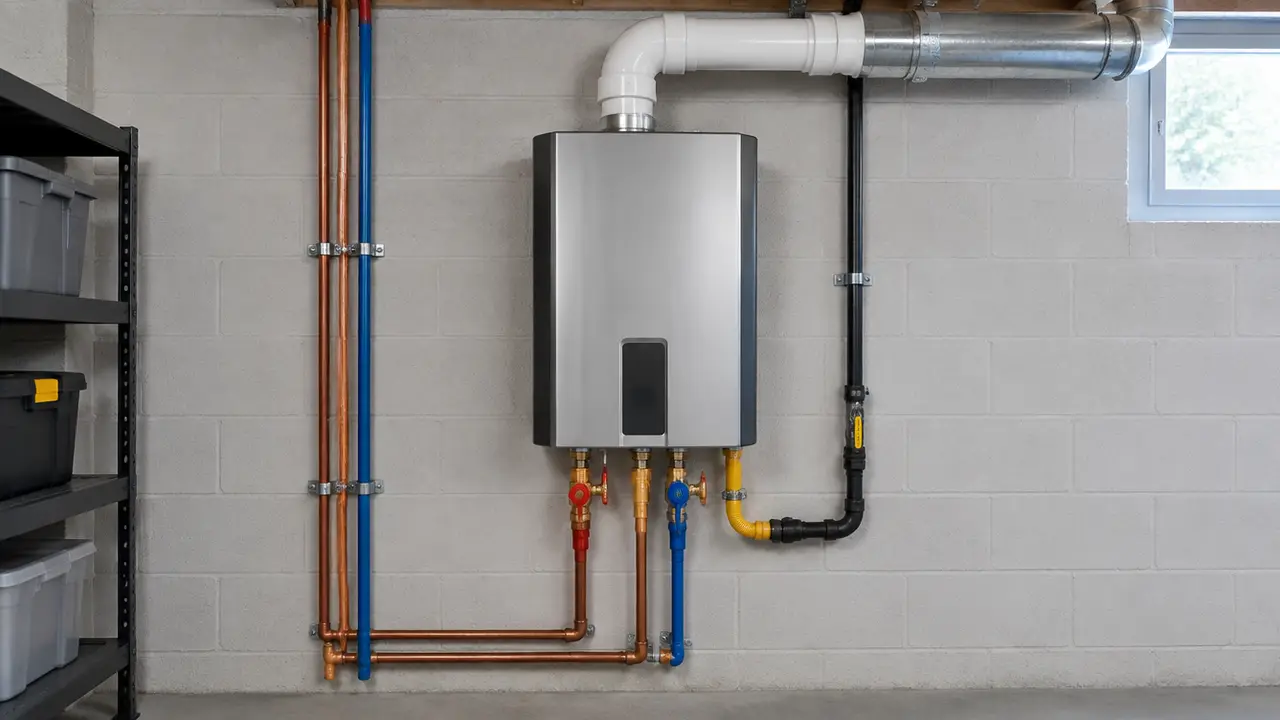
Often not without changes, which is where much of a tankless conversion's cost sits. Natural Resources Canada notes that a gas-fired tankless heater will typically require a 1.9 cm (3/4 in.) supply, compared with 1.2 cm (1/2 in.) for a standard water heater. The meter and piping must also carry the new input on top of the furnace, range, dryer and fireplace running together. A licensed gasfitter sizes that from the total load and pipe length, under a gas permit; see permits and code.
Venting is the other constraint. Natural Resources Canada describes gas on-demand heaters as usually mounted on an outside wall and vented through a side wall. Condensing units vent through plastic pipe listed for that unit and produce condensate that must be drained away, often through a neutralizer to a floor drain. Termination clearances from windows, doors, the gas meter and grade come from the CSA B149.1 gas code and the manufacturer's instructions, and a sidewall vent must be kept clear of snow; Health Canada advises inspecting exhaust vents during and after snowstorms.
| Item | Planning range | When it applies |
|---|---|---|
| Condensing gas tankless, converting from a tank | $4,500–$8,000 installed | The whole job, typical house |
| Gas line upsizing | $300–$1,200 | When the existing line or meter cannot carry the input |
| New plastic vent run to a wall | $300–$1,200 | Almost every conversion from an atmospheric tank |
| Condensate drain or pump | $100–$400 | Condensing units |
07 /Is whole-home electric tankless realistic in Canada?
Rarely, because the current needed for winter showers approaches or exceeds a whole house's electrical service. Two showers from 7 °C water need about 186 A at 240 V, and about 208 A from 2 °C water, for the water heater alone. Natural Resources Canada's guide says most electric on-demand heaters cannot supply an entire house and are rarely installed in Canada for that purpose. The U.S. Department of Energy guideline adds that most electric tankless units need 208 or 240 volts and 50 to 200 amps, may need several circuits, and can require a larger service.
| Current at 240 V | Power | Flow at a 42 °C rise (7 °C in) | Flow at a 47 °C rise (2 °C in) |
|---|---|---|---|
| 100 A | 24 kW | 8.2 L/min | 7.3 L/min |
| 150 A | 36 kW | 12.3 L/min | 11.0 L/min |
| 200 A | 48 kW | 16.4 L/min | 14.6 L/min |
One hundred amps of heater buys roughly one winter shower. That is why electric tankless units here usually serve a single distant sink or a small suite, planned at $800 to $2,000 installed in the tankless vs tank guide. An electrician must confirm the panel and wiring first.
08 /How do you turn the numbers into a quote request?
- The fixtures you run at once, and the total flow in L/min.
- Your measured late-winter inlet temperature and the delivery temperature you want.
- The kW and BTU/h (or amps) you worked out, so quotes can be compared at the same rise.
- The gas line size at the heater, the distance to the meter, and every other gas appliance.
- Where a sidewall vent could terminate and where condensate can drain.
- Your water hardness, because scale shortens heat exchanger life; see tankless water heater maintenance and ask for service valves.
With that list, installers quote like for like. The tankless vs tank guide covers whether tankless suits you at all; request quotes when the numbers are settled.
FAQQuestions people ask
How big a tankless water heater do I need?
Add the flows of the fixtures you run together, then size for your coldest incoming water. With 7 °C water and 49 °C delivery, one shower needs about 80,000 BTU/h, a shower and a sink about 140,000, and two showers about 160,000.
What size tankless replaces a 40-gallon tank?
Match the overlap the tank covered. If one shower and a sink often run together, about 140,000 BTU/h covers it with 7 °C water; if two showers overlap, about 160,000 BTU/h, rising to about 179,000 with 2 °C water.
Can one tankless unit run two showers at once in winter?
A gas unit of about 160,000 BTU/h or more can, with 7 °C water and 49 °C delivery. With 2 °C water it needs about 179,000 BTU/h. Smaller units lower the flow or let the temperature drop when the second shower starts.
Does a tankless water heater need a bigger gas line?
Usually. Natural Resources Canada notes a gas tankless unit typically needs a 3/4-inch supply where a standard tank uses 1/2-inch, and the meter and main line must carry the combined load of every gas appliance.
Can a tankless water heater vent through the roof?
Many can vent through a sidewall or the roof, using only vent materials listed for that unit and the clearances in the gas code and the manual. Natural Resources Canada describes a side wall vent as the usual arrangement for gas on-demand heaters.
SOURCESSources and further reading
- Natural Resources Canada — Water Heater Guide (PDF)
- Natural Resources Canada — Gas-fired instantaneous water heaters (Energy Efficiency Regulations)
- U.S. Department of Energy, Building America — Measure Guideline: Transitioning to a Tankless Water Heater (PDF)
- City of Calgary — Water quality, water hardness and water data
- Health Canada — Preventing carbon monoxide exposure