Rumbling and popping in a gas water heater is almost always sediment: water trapped under a layer of scale on the tank bottom boils into steam bubbles that burst as they rise. Flushing usually quiets it. Sizzling in an electric tank means scale on the elements. Ticking is pipes expanding. Hissing, screeching or a gas smell need a closer look.
- Rumbling and popping come from sediment on the tank bottom; the sound is steam bubbles forming and collapsing.
- The noise itself is not dangerous, but the sediment behind it overheats the steel and shortens tank life.
- Flush early; a tank that has rumbled for years may not quiet down, and may be near the end of its life.
- Ticking, humming and a brief hiss from condensation on a cold gas tank are usually normal.
- Screeching, continuous hissing, a relief valve that roars, or any gas smell means act now.
01 /Why does my water heater rumble and pop?
A water heater rumbles and pops because sediment has built up on the bottom of the tank. On a gas tank, the burner heats the bottom head directly. Water trapped in and under the sediment layer cannot circulate, so it gets far hotter than the water above it and flashes into steam. The bubbles push up through the sediment and collapse in the cooler water, which you hear as popping, knocking or a rolling rumble each time the burner fires. Plumbers sometimes call it kettling, after the sound a kettle makes as it nears the boil.
Sediment is mostly calcium carbonate that drops out of hard water as it is heated, plus sand, grit and flakes of scale. Calgary is a good example of why this is common: the City's published hardness figures run from roughly 140 to 275 milligrams per litre as calcium carbonate depending on the treatment plant and season. The noise is usually loudest when the burner first fires after a large draw of cold water.
02 /What does each water heater noise mean?
Each sound points to a different cause. Match the noise, then check the table's next step. For hissing, whistling, humming, knocking and clicking in more depth, see water heater noises.
| Sound | Where and when | Likely cause | What to do |
|---|---|---|---|
| Rumbling, popping, knocking | Gas tank, while the burner runs | Sediment on the tank bottom | Flush; if it persists on an old tank, plan replacement |
| Sizzling or crackling | Electric tank, while elements heat | Scale on the heating elements | Flush; consider replacing scaled elements |
| Brief sizzle or hiss | Gas tank, burner area, after a big cold draw | Condensation dripping onto the burner | Normal if it stops as the tank warms |
| Continuous hissing | Near the tank or a fitting | Water leak onto a hot surface, or a relief valve seeping | Find the source; see hot water tank leaking |
| Ticking or tapping | Pipes on top of the tank or in walls | Pipes expanding and contracting; heat trap nipples | Usually harmless; better pipe supports help |
| Screeching or whistling | At a valve or the tank inlet | A partially closed valve restricting flow | Open the supply valve fully; replace a failing valve |
| Banging when a tap closes | In the walls | Water hammer from fast-closing valves | Arrestors or pressure control; not the tank |
| Humming | Electric tank or heat pump unit | Element vibration, or normal compressor and fan noise | Normal unless it changes character |
| Grinding or rattling fan | Power-vent blower | Worn fan bearing or debris | Technician; see power vent in winter |
| Beeping | Electronic units, or a leak alarm | Error code, low battery, or detected water | Read the display or manual; check for water |
| Roaring rush of water or steam from the relief pipe | T&P discharge | Valve opening on high temperature or pressure | Turn off the heat, keep clear, call a technician |
03 /Is a rumbling water heater dangerous?
The rumbling itself is not an explosion warning. It is a sign of sediment. A storage tank's protection against dangerous pressure and temperature is the T&P relief valve, and as long as that valve and its discharge pipe are intact and unobstructed, sediment noise does not make a tank likely to burst. Can a water heater explode? explains what would actually have to fail.
The noise does mean harm, though, just slower. Sediment insulates the bottom of the tank, so the burner runs longer to heat the same water, which wastes gas. The steel under the sediment runs hotter, which stresses the glass lining and speeds corrosion. On electric tanks, sediment can bury the lower element, which then overheats and fails. A tank that has rumbled loudly for years is usually a tank near the end of its life.
The rumble is the tank telling you about its bottom. Listen early and a flush fixes it; ignore it for years and it becomes a replacement.
04 /How do I stop my water heater from rumbling?
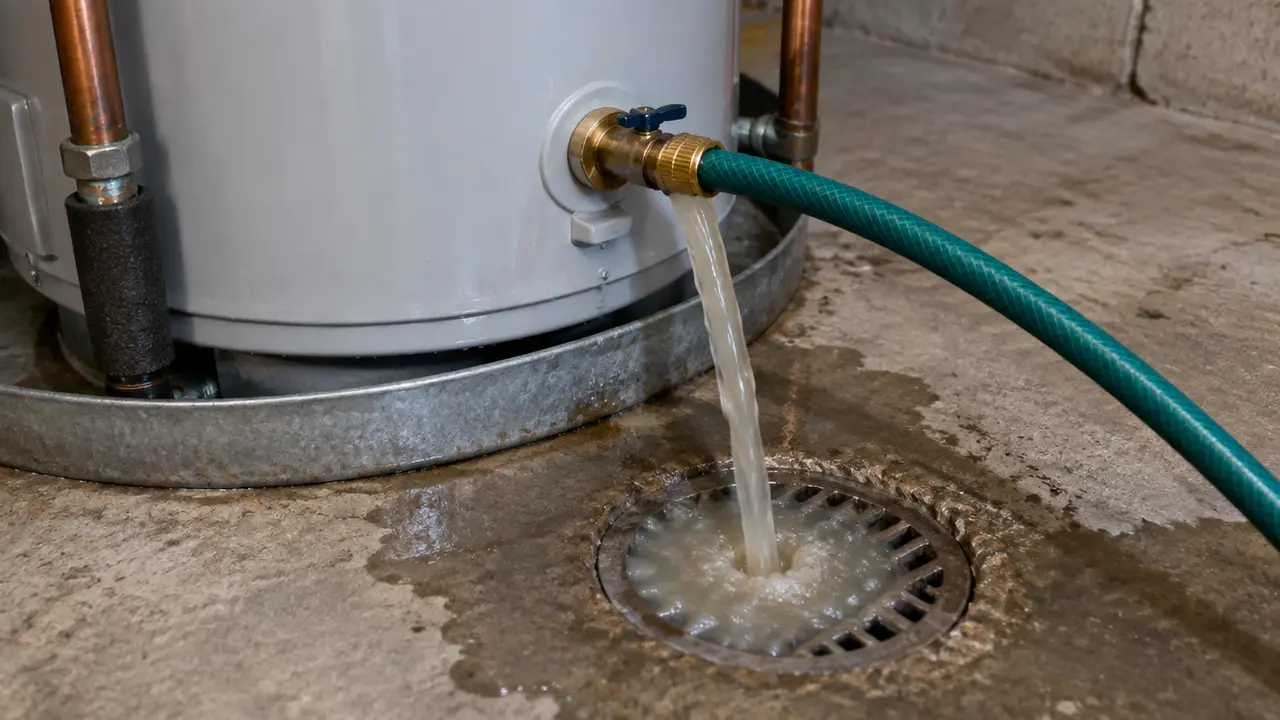
Flushing the tank is the fix. The goal is to stir up and drain the loose sediment so the burner heats water again instead of a layer of scale.
- Turn off the heat
Gas control to PILOT or OFF; electric or heat pump breaker off.
- Drain and stir
Attach a hose to the drain valve, open a hot tap, and drain. Close the cold supply to let the tank empty, then open it in short bursts to churn the sediment off the bottom.
- Repeat until clear
Several cycles are normal for a noisy tank. Stop if the drain valve clogs or seems fragile.
- Refill completely, then restore heat
Keep a hot tap open until water flows steadily, then relight or switch the breaker back on.
- Listen at the next firing
Quieter means it worked. If it still rumbles loudly, packed scale remains.
The full procedure, with its stop conditions, is in how to flush a hot water tank. Some manufacturers approve specific descaling products for tanks; use them only as the manual directs. On electric tanks with heavily scaled elements, replacing the elements during the flush often ends the sizzling.
05 /What if flushing doesn't stop the noise?
If a thorough flush does not quiet the tank, the sediment is packed hard, or large pieces of scale are too big to pass through the drain valve. At that point the options are narrower.
- A technician can fit a full-port drain valve or use a tank-cleaning wand through the drain opening to break up and remove scale. This works on some tanks and not others.
- Accept some noise on a younger tank if it is dry, the water is clear and recovery is acceptable, and keep flushing on schedule to stop it getting worse.
- Plan a replacement on an older tank. A tank near or past its typical range that still rumbles after flushing has usually lost a lot of its lining and anode protection. Run it through the Tank Lifespan Predictor to see where it sits.
When replacing, think about prevention. In hard-water homes, a water softener reduces scale but consumes anodes faster; a tankless unit needs regular descaling instead of flushing; a heat pump tank still collects sediment. The choosing a water heater checklist covers these trade-offs, and you can request quotes when you are ready.
06 /How do I keep a water heater quiet?
Prevention is simpler than cure. A tank that is flushed from its first year rarely builds enough sediment to rumble.
| Habit | Why it works |
|---|---|
| Flush yearly, or every six months in hard water | Removes sediment before it packs down |
| Drain a few buckets every few months | Clears loose sediment between full flushes |
| Keep the setting near 60 °C, not higher | Scale forms faster at higher temperatures |
| Inspect the anode every few years | A healthy anode protects the tank the sediment is stressing |
| Add a sediment filter on well supplies with sand | Stops grit entering the tank at all |
Put these into a calendar with the water heater maintenance schedule, and use the Tank Explorer age slider to see how sediment builds in a typical tank over fifteen years.
FAQQuestions people ask
Is it normal for a water heater to make noise?
Some noise is normal: ticking pipes, a brief sizzle from condensation on a cold gas tank, the hum of a heat pump unit or power-vent fan. Loud rumbling, popping, screeching or continuous hissing is not normal.
Can a water heater explode from sediment?
Sediment alone does not make a tank explode. Explosions are extremely rare and involve a failed control plus a disabled or blocked T&P relief valve. Keep that valve and its discharge pipe unobstructed and never cap them.
Why does my water heater pop when it is heating?
Popping while the burner or elements run is steam bubbles forming under sediment and collapsing in the cooler water above. A flush usually reduces it.
Why does my water heater make noise when no hot water is running?
A tank reheats on its own as it loses heat, so the burner or elements can fire at any time, and sediment noise happens then too. Ticking can also come from pipes cooling. A beep or fan noise with no heating suggests an electronic fault code.
Why is my water heater beeping?
Electronic water heaters beep to signal an error or a need for service, and many leak alarms beep when they detect water. Read the display or the manual's code list, and check the floor around the unit.
Will vinegar remove sediment from a water heater tank?
Some owners use it, but manufacturers differ on descaling products for tanks. Follow your manual. For tankless units, descaling with a manufacturer-approved solution is routine maintenance.