If your hot water tank is leaking, turn off the gas or power to it, close the cold supply valve on top, and keep water away from electrical parts. Then find the source: leaks from pipe fittings, the drain valve or the relief valve are usually fixable, and condensation dries once the tank heats. Water seeping from the tank body means the tank has failed and must be replaced.
- First make it safe: heat off, cold supply closed, water away from electrical parts, and leave if you smell gas.
- Where the water comes from matters more than where it pools; dry everything and watch where it reappears.
- Top leaks are usually fittings, the anode port or the relief valve threads and are repairable.
- Water from the relief valve's discharge pipe is a pressure or temperature symptom, not a tank leak.
- A leak from the tank body or bottom seam cannot be repaired; plan a replacement.
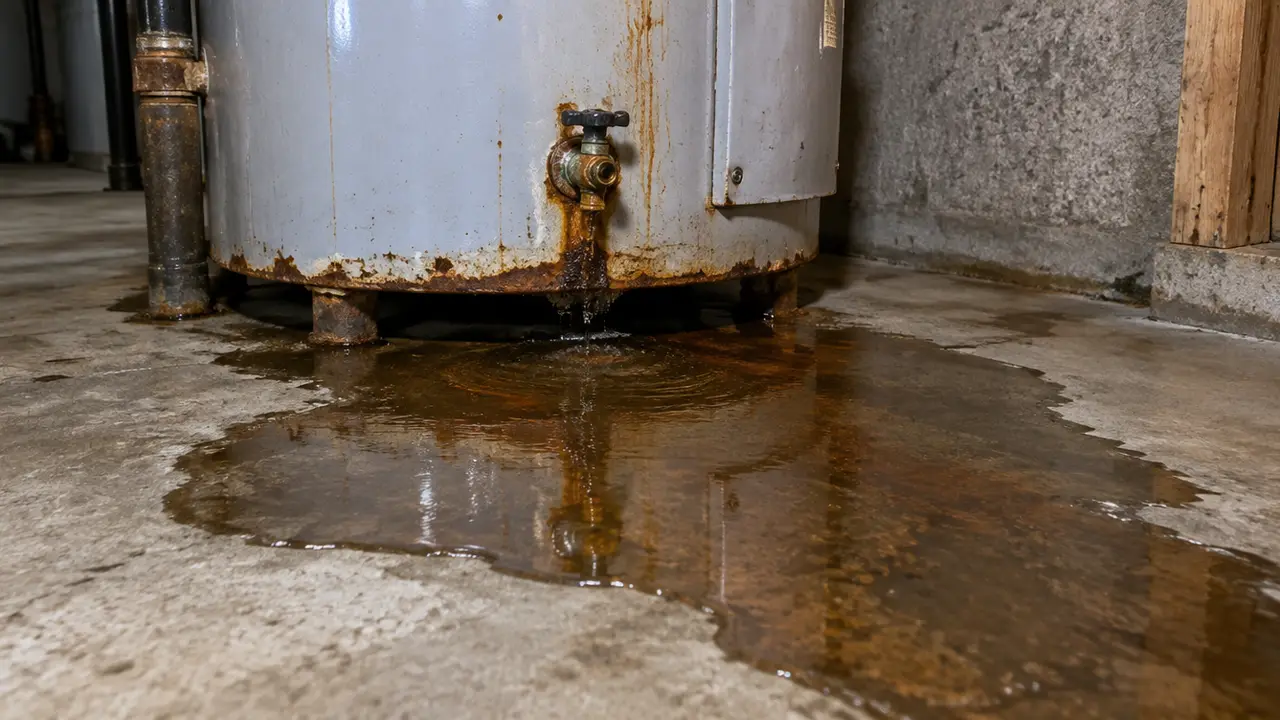
01 /What should I do right now if my hot water tank is leaking?
Make the tank safe before you investigate: stop the heat, stop the water, and protect people and electrical parts. A slow drip is not an emergency; a tank leaking steadily near finished space or electrical equipment is.
- Turn off the heat
Gas tank: turn the control knob to OFF. Power vent: also unplug it or switch off its circuit. Electric or heat pump: switch off its breaker at the panel, if you can reach the panel on a dry floor.
- Close the cold supply valve
It is on the cold pipe entering the top of the tank. A lever handle turns a quarter turn; a round handle turns clockwise. This stops the tank refilling.
- Contain the water
Put down towels and a bucket or tray. Move stored boxes and anything electrical away from the tank.
- Relieve pressure if the leak is at the tank
Open a hot tap somewhere in the house. With the cold supply closed, pressure drops and most fitting leaks slow.
- Drain the tank if the body is leaking
Attach a hose to the drain valve, run it to a floor drain, open a hot tap and open the drain valve. The water may be hot, so route it carefully.
- Document it
Take photos and note the time. If water has damaged finishes, your insurer will want them.
Once it is safe, use the table in the next section to trace the source. The Water Heater Troubleshooter walks through the same checks with separate paths for leaks at the top and bottom.
02 /Where is my water heater leaking from?
Find the true source by drying the tank, fittings and floor completely, then watching where water first reappears. Water runs down the jacket and pools at the lowest point, so a puddle at the base often starts at the top.
| Where the water appears | Likely cause | Fixable? |
|---|---|---|
| Top: cold or hot connection | Loose or corroded fitting, failing dielectric union or flexible connector | Usually yes |
| Top: around the anode hex | Corroded threads or seal at the anode port | Usually yes (reseal or new anode) |
| Top: around the T&P valve threads | Corroded or loose valve threads | Usually yes (new valve) |
| From the end of the T&P discharge pipe | Valve opening on pressure or temperature, or a worn seat | Yes; find the cause first |
| Bottom: from the drain valve outlet or stem | Valve not fully closed, grit on the seat, worn plastic valve | Yes (cap or replace valve) |
| Bottom: inside the burner compartment, only after a big cold draw | Condensation from flue gases on the cold tank | Normal if it stops as the tank heats |
| Bottom: steady seep at the base, rust streaks, wet insulation | Tank shell corroded through | No; replace |
| Electric: behind the element cover | Element gasket leak, or tank leak at the element port | Gasket yes; tank no |
| Tankless: from the unit or its fittings | Fitting, pressure relief valve, or a failed heat exchanger | Depends; call a technician |
If you cannot see the top of the tank because of a low ceiling or ductwork, a phone camera held above it on a stick shows the fittings. Pay particular attention to white, green or rusty crust around fittings: that is evidence of a slow leak that evaporated for months before it finally dripped.
03 /Why is my hot water tank leaking from the top?
A leak at the top of a hot water tank is almost always a connection rather than the tank itself. The cold inlet, hot outlet, anode port and T&P valve all thread into the top, and each can loosen or corrode.
- Pipe connections: threaded steel nipples and dielectric unions (which separate copper from the steel tank) corrode over time. Flexible water connectors can wear out. Tightening can help a loose fitting; a corroded one needs replacing.
- Relief valve threads: water around the T&P valve body, rather than from its discharge pipe, usually means corroded threads. The valve is replaced, not patched.
- Anode port: a seep around the anode hex often means corroded threads. Replacing the anode with fresh sealant usually cures it.
- Condensation on cold pipes: in humid summer weather, cold water pipes sweat. Insulating them stops the drips, and Natural Resources Canada notes pipe insulation near the tank also saves energy.
- Vent condensation: on gas tanks, water can drip back down a vent that is poorly sloped or cold. That is a venting issue for a technician.
Can a hot water tank leak from the top of the tank itself? Rarely, but it happens when the top head corrodes around a fitting. If the fittings are dry and water still appears on top, the tank has failed.
04 /Why is my hot water tank leaking from the bottom?
Water at the bottom comes from one of four places: the drain valve, water running down from a fitting above, condensation inside a gas tank's burner area, or the tank body itself. The first three are fixable. The last is not.
The drain valve is the easiest to check. Wipe it dry and hold a paper towel at its outlet and around its stem. Drips from the outlet mean it is not sealing; a hose cap stops them until the valve is replaced. Drips from the stem or body mean the valve itself is failing.
Condensation is the most misunderstood bottom leak. When a gas tank is full of cold water, for example after a long shower or first thing in the morning, the burner's hot, moist combustion gases condense on the cold tank surfaces and drip onto the burner, sometimes with a hiss. It stops once the tank warms up. If the dripping continues for hours after the tank is hot, it is not condensation.
The tank body leaks when its steel has corroded through, usually at the bottom seam or near the burner. Signs are a steady seep at the base, rust streaks down the jacket, wet insulation at the burner access, and water inside the burner area on a hot tank. See signs your water heater is failing and how long hot water tanks last.
05 /Why is water coming out of the relief valve or overflow pipe?
Water from the pipe running down the side of the tank is the temperature and pressure (T&P) relief valve doing its job, or a valve that has started to wear. It is not a tank leak, but it is a symptom worth diagnosing, because the valve protects the tank from dangerous pressure and temperature.
Common causes are thermal expansion in a home with a pressure-reducing valve or check valve and no working expansion tank, supply pressure that is too high, a worn valve seat after years of service or a test, and, rarely, a tank that is overheating. Never cap or plug the discharge pipe. The full diagnosis is in T&P valve dripping, and thermal expansion control is explained in expansion tanks.
06 /Can a leaking hot water tank be fixed, or does it need replacing?
A leaking hot water tank can be fixed when the leak is at a fitting, valve, gasket or anode port. It cannot be fixed when the water is coming from the tank body, because the steel shell has corroded through and no patch lasts under pressure and heat. Sealants and epoxy on a tank body are not a repair.
Is a leaking hot water tank dangerous? The water itself is mainly a property-damage risk, and hot water can scald. The real hazards are water reaching electrical parts, a flooded gas burner or control, and a gas leak mistaken for a water problem. A gas control that has been under water should be inspected and normally replaced by a technician before the heater is used again.
If replacement is the answer, the replacement cost guide sets expectations, the choosing a water heater checklist helps you decide what to install, and you can request quotes. If the tank is rented, call the rental provider first; see rental vs buy.
07 /Is a leaking water heater covered by insurance?
Home insurance policies vary, so the only reliable answer is in your own policy wording. As a general pattern, many policies treat sudden and accidental water damage to the home differently from the failed appliance itself, and many exclude gradual leaks and wear. Call your broker or insurer, describe what happened and when you found it, and ask before you throw away damaged materials.
Your photos, the time you found the leak and the tank's age all help. A drip pan piped to a drain, or a leak alarm with an automatic shut-off valve, reduces the damage next time and is worth asking about when the tank is replaced. Water heater leak protection compares those devices, and water heater leaks and home insurance explains how claims are usually handled.
FAQQuestions people ask
Is a hot water tank leak an emergency?
A slow drip from a fitting is not; turn off the heat and cold supply and book a repair. A steady leak near finished space or electrical equipment, any gas smell, or water reaching wiring is urgent: make it safe first and call for help.
Can I still use hot water if my tank is leaking?
If the leak is from the tank body, no: turn it off, close the cold supply and drain it. If it is a small fitting or drain-valve drip, the tank can often run until the repair, but keep the area dry and watch it.
Why is my hot water tank leaking but I still have hot water?
Most leaks do not affect heating. A fitting, relief valve or drain valve can leak while the tank works normally. A tank-body leak can also start while the tank still heats, so find the source rather than judging by the water temperature.
Why is my hot water tank leaking and there is no hot water?
On a gas tank, water may have put out the pilot or soaked the burner, which can mean a failed tank. On an electric tank, a leak at an element can cause the element or breaker to fail. Keep the heat off and have it inspected.
How do I stop my hot water tank from leaking?
Close the cold supply valve on top and turn off the heat. Opening a hot tap relieves pressure and slows most fitting leaks. For a tank-body leak, drain the tank through the drain valve.
Is a little water under my gas water heater normal?
A little condensation inside the burner area after a large draw of cold water can be normal and should stop as the tank heats. Water that keeps appearing on a hot tank, or rust at the base, is not normal.