Good water heater leak protection layers three things: a drain pan piped to a floor drain, which catches drips; a leak alarm or smart detector, which tells you water is there; and an automatic shut-off valve on the cold supply, which stops the tank refilling. Add a nearby floor drain, strap the tank where seismic rules call for it, and test every device.
- A failed tank keeps refilling from the supply, so the aim is to shorten the time water runs before someone or something stops it.
- The National Plumbing Code requires a drained pan where a tank sits over a wood floor or in a ceiling or roof space; an unpiped pan is only a tray.
- Automatic shut-off valves go on the cold supply, never between the tank and its relief valve or on the discharge pipe.
- Keep an expansion tank on the heater side of an automatic valve so it still works when the valve closes.
- Some insurers ask about leak devices; check your policy and ask your broker what counts.
01 /Why does a water heater need leak protection?
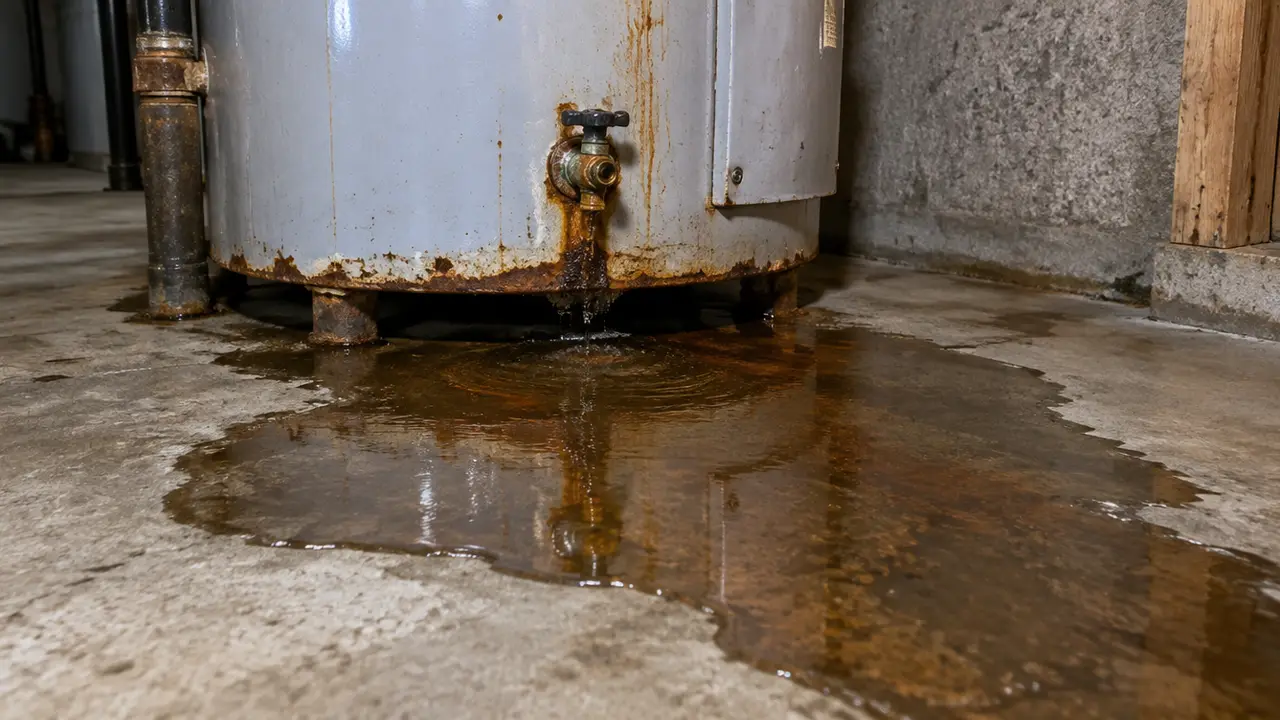
Because it holds a lot of water and stays connected to a lot more. Most household tanks hold 151 to 284 litres (40 to 75 US gallons), and when one fails it does not just empty: the cold supply keeps refilling it until someone closes the valve. A burst at night in a finished basement, or in a closet above living space, can run for hours. Leak protection shortens that time by catching the first drips, raising an alarm and cutting the supply without waiting for you.
| Layer | What it does | What it cannot do |
|---|---|---|
| Drain pan piped to a drain | Catches drips and small leaks and carries them away | Handle a full tank failure by itself |
| Leak alarm with a battery sensor | Sounds when water touches the sensor | Help when nobody is home to hear it |
| Smart leak detector | Sends an alert to your phone | Work without power, a network connection or a charged battery |
| Automatic shut-off at the heater | Closes the heater's cold supply when a sensor gets wet | Stop leaks elsewhere in the house |
| Whole-home automatic shut-off | Closes the main supply on a sensor signal or abnormal flow | Stop the water already in the tank from draining out |
| Floor drain close by | Gives escaping water a route away | Keep up if it is blocked or across the room |
| Seismic straps | Keep the tank upright so its pipes are not torn in an earthquake | Prevent ordinary corrosion leaks |
No single layer covers every failure. A pan plus an automatic valve handles most tank leaks, and an alarm or smart detector tells you something happened while you can still act. The leaking tank guide covers what to do once water is on the floor.
02 /When is a drain pan required, and where must it drain?
The National Plumbing Code of Canada (2025 edition) requires a storage-type water heater located in a ceiling or roof space, or over a floor of wood construction, to sit in a corrosion-resistant, watertight drain pan. The code sets three details for that pan:
- it must be at least 50 mm larger than the tank, with side walls at least 25 mm high;
- it must be drained by a pipe two pipe sizes (NPS) larger than the relief valve discharge pipe; and
- its drain must sit directly under the relief valve discharge pipe and discharge straight to a floor drain or another acceptable location.
Provinces adopt the model code on their own schedules and sometimes amend it, so confirm the edition in force where you live. The rule also exposes a common mistake: a pan that is not piped anywhere is only a tray. It holds a few litres, overflows, and gives false comfort. Where no drain is close, ask the installer about running the pan drain to one, or pairing the pan with an automatic shut-off valve.
A tank on a concrete basement slab falls outside that code rule, but a pan still earns its place where the floor is finished or the drain is across the room. On gas tanks, use a pan the heater's installation instructions allow, so it does not interfere with combustion air openings or burner access at the base.
03 /What should you look for in a water heater leak alarm?
A leak alarm is a small battery unit with contacts underneath that sounds when water bridges them. It is the cheapest layer and the one most often placed badly: a sensor in the wrong spot stays dry while water runs past it.
- Placement. Put the sensor on the floor on the low side of the tank, or inside the pan near its drain, where the first water collects, not on a box or shelf that water will flow around.
- Loudness. An alarm in a utility room two floors below the bedrooms may not wake anyone. Choose one you can hear from where you sleep, or one that links to other alarms.
- Battery warning. A low-battery chirp matters. Write the replacement date on the unit.
- Testing. Touch the contacts with a wet cloth every few months and after each battery change.
Smart leak detectors add a phone notification, which is what makes an alarm useful when the house is empty. They depend on power or batteries, the home network and the service behind the app, so check what they do during a power or internet outage. Some pair with a smart shut-off valve, so the alert and the valve work together.
04 /How do automatic shut-off valves work?
An automatic shut-off valve is a motorised or spring-loaded valve that closes a water line when it receives a signal. Water heaters are usually protected by one of two sensor-driven arrangements, and a third type watches flow instead of the floor.
| Type | Where it goes | What triggers it | What it protects |
|---|---|---|---|
| Water heater shut-off | The cold supply to the heater, above the tank | A floor or pan sensor gets wet | The tank and its connections |
| Whole-home shut-off with sensors | The main supply, after the main shut-off valve | Any linked sensor gets wet | Every fixture and appliance with a sensor |
| Whole-home shut-off with flow monitoring | The main supply | Unusual flow, such as water running for hours | Leaks where no sensor sits, including inside walls |
Placement matters more than the model. The valve belongs on the cold supply, upstream of the heater. The National Plumbing Code prohibits any shut-off valve on the pipe between a tank and its relief valves or on the relief valve discharge pipes, so an automatic valve must never sit on the hot outlet ahead of the T&P valve or on the discharge line.
- Thermal expansion. If your home is a closed system with an expansion tank, ask the installer to keep the expansion tank between the automatic valve and the heater, so it still absorbs expansion after the valve closes.
- Heat source. Closing the water does not turn off the burner or elements. Some systems can also signal the heater to shut down; on a gas heater, any device that interrupts the gas supply is gas work for a licensed gas technician.
- Override and power. Know how to reopen the valve by hand and whether it has battery backup, and cycle it a few times a year so it does not seize.
After a valve trips, find and fix the leak before reopening it. If it closes for no visible reason, look for condensation dripping onto a sensor, and move the sensor rather than disabling it.
05 /Why should a water heater sit near a floor drain?
Because every device can fail, and gravity does not. A tank a metre from a floor drain, on a floor that falls toward it, sends escaping water away before it reaches finished walls. A tank in a closet or on a wood floor with no drain depends entirely on its devices.
- Keep the drain working. The Insurance Bureau of Canada's home risk advice includes keeping floor drains clear of obstructions. Nothing should be stored over it, and it should drain freely.
- Keep the trap wet. A floor drain that rarely sees water can dry out and let sewer gas in; pour water into it every few months.
- Keep the path clear. Store boxes, rugs and electronics away from the tank and the route to the drain.
- Think about basement water. IBC also suggests minimizing basement water damage by elevating the furnace, hot water heater and electrical panel, or relocating them to a higher level.
- Plan the location at replacement. Moving a heater costs more than a like-for-like swap because of gas, venting and piping changes, but a replacement is the cheapest moment to do it. The installation guide covers what a relocation involves.
06 /Where are seismic straps required on a water heater?
Seismic straps hold a tank to the wall so ground shaking cannot tip it over and tear its water and gas connections. They matter most in the higher-seismic parts of Canada, especially coastal British Columbia. The Province of British Columbia's PreparedBC earthquake guidance tells residents to anchor water heaters snugly to the wall with straps and, if necessary, to have a licensed gas fitter install a flexible gas line.
Whether straps are mandatory depends on the building code your province has adopted and where you live. The National Plumbing Code's seismic article applies to plumbing in larger buildings designed under Part 3 of the National Building Code, not to a typical house, so ask your municipality or installer whether restraint is required at your address. Where straps are fitted:
- use a strap kit made for water heaters, following its instructions and the heater's;
- anchor into studs or masonry, not drywall alone;
- leave the controls, drain valve and access panel reachable; and
- have the gas connector checked so the tank can shift slightly without straining the gas line.
PreparedBC also reminds residents that if gas is shut off at the meter, only a licensed gas contractor should turn it back on.
07 /Do insurers ask for or reward leak protection?
Some do, and practice varies by insurer and province. An insurer may ask about water protection devices on an application, price a policy differently where certain devices are installed, or ask for them on homes with older plumbing or a history of water claims. None of that is standard across Canada, so check your policy and ask your broker which devices count, whether they must be monitored or professionally installed, and what proof to keep.
Keep the invoice, the model details and a photo of each device in place. If a leak does happen, a working shut-off and a record of its installation show the adjuster that you took reasonable steps. The home insurance guide explains how water heater claims are usually treated.
08 /What does leak protection cost, and when should you add it?
The cheapest time is during a replacement, when the tank is out and the installer is already working on the cold line. The site's replacement cost guide plans a drain pan with a leak sensor and automatic shut-off at $150 to $600 added to a replacement. A whole-home valve, or a long run to carry a pan drain to a distant floor drain, costs more and is worth quoting separately.
- Is a pan required here?
Ask whether the location triggers the code's pan rule and where the pan's drain will go.
- Which shut-off, and where?
Heater-only or whole-home; on the cold supply; the expansion tank on the heater side.
- What happens in an outage?
Battery backup, manual override, and what a smart device does without internet.
- Are straps needed?
In seismic regions, whether restraint is required and whether the quote includes it.
- How is it tested?
How to test each device, and how often.
Put these items in a quote request so installers price the same scope, and check T&P valve dripping if water keeps appearing from the discharge pipe rather than the tank.
FAQQuestions people ask
What is the best hot water heater leak alarm?
HotWaterTank.ca does not rank brands. The best one for your home is loud enough to hear from where you sleep, warns of a low battery, lets its sensor sit on the floor or in the pan, and sends a phone alert if you are often away.
Does a water heater need a drain pan?
Under the National Plumbing Code of Canada, a drained pan is required where a storage-type heater sits in a ceiling or roof space or over a wood floor. On a basement slab it is optional but useful where the floor is finished. Confirm your province's adopted code.
Can a drain pan go under a gas water heater?
Yes, if the pan is one the heater's installation instructions allow, so combustion air openings and burner access at the base stay clear. It is easiest to set when the tank is installed.
Where does an automatic shut-off valve go on a water heater?
On the cold supply feeding the heater, upstream of the tank. It must never go between the tank and its T&P relief valve or on the relief valve's discharge pipe.
Do water heaters need earthquake straps in Canada?
In seismic regions, particularly coastal British Columbia, PreparedBC recommends strapping and local code may require it. Confirm with your municipality or installer.
How often should I test a water leak alarm?
Every few months with a wet cloth across the contacts, and after every battery change. Test an automatic shut-off by wetting its sensor and checking that the valve closes and reopens.