The clearest signs a water heater is failing are water leaking from the tank body, rust-coloured hot water, loud rumbling or popping, a smell of gas or scorching near the unit, and age past its typical range. A tank-body leak or any gas, scorching or carbon monoxide warning means stop and call now; most other signs mean plan the replacement.
- Gas smell, scorch marks, a carbon monoxide alarm or water near electrical parts are stop-now signs, not maintenance items.
- A leak from the tank body itself cannot be repaired; leaks from fittings and valves usually can.
- Rust in the hot water only usually points to a spent anode and a tank that is corroding from inside.
- Rumbling, shrinking hot water supply and repeated part failures on an older tank are signs to start planning.
- Symptoms matter more when the tank is past the start of its typical life range.
01 /Which water heater symptoms mean stop now?
Five symptoms mean you should stop troubleshooting and make the situation safe before anything else: a gas smell, a carbon monoxide alarm, scorch marks or melted parts at the top or burner area, water reaching electrical parts, and water coming from the tank body. None of these is a maintenance task.
| Sign | What it can mean | First action |
|---|---|---|
| Smell of gas (rotten eggs in the air, not the water) | Gas leak at a fitting, the control or the supply line | Leave the house, do not touch switches, call the gas utility or 911 from outside |
| Carbon monoxide alarm sounds | Combustion gases spilling indoors from the water heater or another appliance | Get everyone out to fresh air and call 911 from outside |
| Scorching, soot or melted plastic at the draft hood, burner door or top fittings | Flue gases spilling or flame rollout | Turn the gas control to OFF if safe; do not relight; call a gas technician |
| Water on or near the electrical panel, junction box, power-vent fan or heat pump electronics | Shock and fire risk | Stay out of the water; cut power at the panel only if you can reach it dry, or call an electrician |
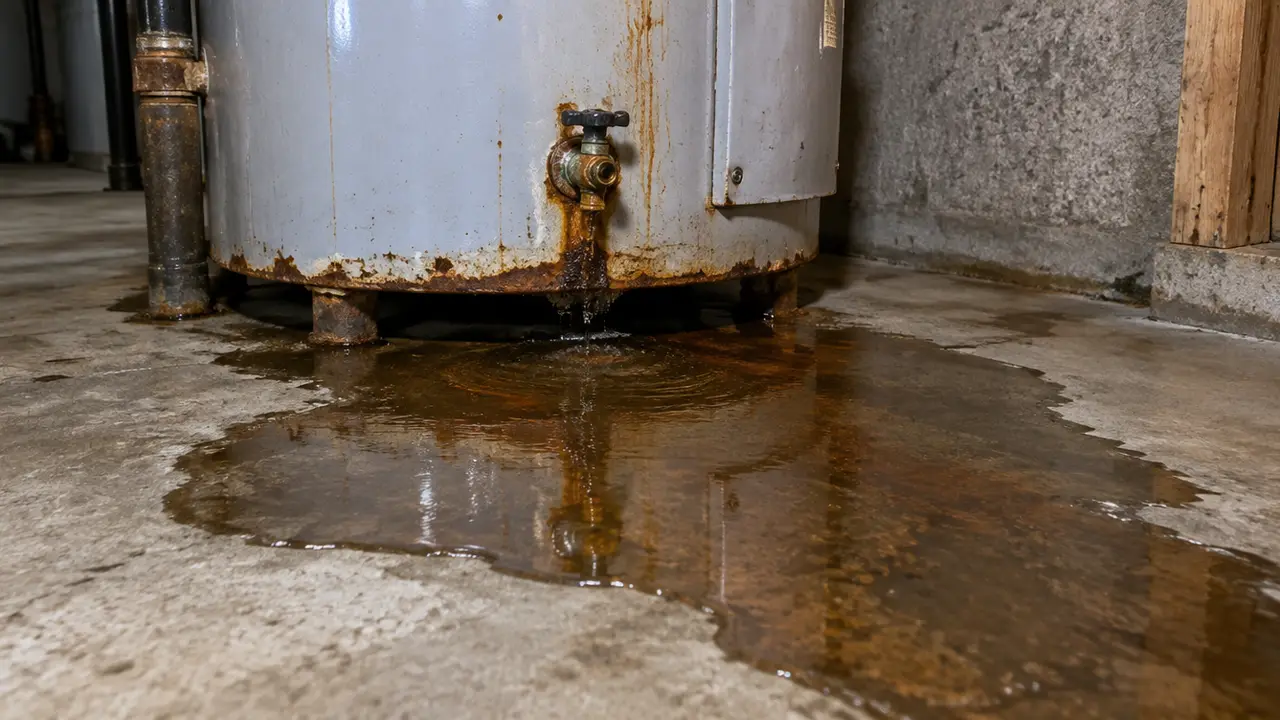
| Water seeping from the tank body or under the jacket | The steel shell has rusted through | Turn off gas or power, close the cold supply valve, arrange replacement |
Carbon monoxide has no smell at all, so a working CO alarm is the only way most households will know it is present. The carbon monoxide and water heaters guide covers alarms, symptoms and venting.
02 /What are the signs a water heater needs replacing soon?
Rust-coloured hot water, a damp base with no obvious fitting leak, and heavy rumbling in an older tank are the signs that a replacement is coming within months, not years. They point to the tank itself, not a replaceable part.
- Rusty or brown hot water, cold water clear. Run cold at a tap first. If cold is clear and hot is rusty, the rust is coming from inside the tank. On a tank within or past its typical range, this usually means the anode is spent and the steel is corroding. Rust in both hot and cold points to the pipes or the municipal supply instead.
- Damp base, rust streaks down the jacket, or water under the burner. Look for a slow seep at the bottom seam, rust bleeding through the jacket, or drips inside the burner compartment of a gas tank that continue after the tank is hot. Early-morning condensation on a gas tank is normal after a big draw of cold water and dries as the tank heats; a wet spot that stays is not.
- Heavy rumbling, cracking or popping. Some noise is sediment. Loud, frequent noise on an older gas tank means a thick layer is overheating the bottom. See rumbling and popping water heater.
- Metallic taste or grit in the hot water. Flakes of scale or bits of the dip tube in faucet aerators show internal breakdown.
- The tank is past its typical life range. Age alone is not failure, but every symptom on an old tank counts for more.
03 /What are early warning signs worth watching?
Early warning signs are usually performance changes: less hot water than before, water that takes longer to reheat, a pilot that goes out now and then, or a T&P valve that drips. Each has a range of causes, some cheap, some terminal, so treat them as prompts to investigate rather than as a verdict.
| Sign | Common causes | Next step |
|---|---|---|
| Hot water runs out sooner | Sediment taking up volume, failed lower element (electric), broken dip tube, thermostat or mixing valve set low, colder winter inlet | Not enough hot water |
| Slow recovery | Scaled elements, weak burner, dirty flame arrestor, undersized unit | Check with the troubleshooter |
| Pilot goes out | Thermocouple, dirty pilot, draft, clogged flame arrestor, gas control | Pilot light won't stay lit |
| T&P valve drips | Thermal expansion on a closed system, high supply pressure, worn valve, overheating | T&P valve dripping |
| Breaker trips (electric) | Shorted element, wiring fault, failing thermostat | Leave it off; call an electrician or technician |
| Water too hot | Stuck thermostat or failed gas control | Lower the setting; if it stays too hot, shut it down and call |
| Power-vent error or fan noise | Blocked vent or intake, failing fan bearing, pressure switch | Power vent in winter |
A single inexpensive failure on a mid-life tank is normal wear. A string of failures on an older tank is the tank telling you its components are all reaching the end together.
04 /How do I check my water heater in ten minutes?
A ten-minute look, once a month or whenever something seems off, catches most problems while they are still cheap. You need a flashlight, a dry paper towel and your nose.
- Smell the air first
Before you get close, check for a gas smell. If there is one, stop and leave. If not, carry on.
- Look at the floor and pan
Wipe the base and the pan with a dry paper towel. Note any water and where it collects.
- Check the top
Look at the cold inlet, hot outlet, T&P valve and vent connection for drips, white or green crust, and rust.
- Look at the flame or listen to the fan
On a conventional gas tank, look through the sight glass: a steady blue flame is normal, a lazy yellow flame or soot is not. On a power vent, listen for bearing noise.
- Check the draft hood and vent
Look for soot, discolouration or melted plastic nearby. These are signs of spillage.
- Feel the discharge pipe
The pipe from the T&P valve should be dry and cool at its outlet.
- Run a hot tap
Watch for colour, grit and smell in the first litre or two.
Photograph anything unusual with the date. A series of photos showing a spot growing is more useful to a technician, and to you, than a memory. Then put the tank's age and symptoms into the Water Heater Troubleshooter and the Tank Lifespan Predictor.
05 /What does a technician check when a water heater is failing?
A plumber or gas technician confirms the failure point before recommending repair or replacement. On a service call you can expect some or all of the following.
- Leak tracing: drying the tank and fittings, then watching where water reappears, to separate a fitting leak from a tank-body leak.
- Combustion and venting check: looking for spillage at the draft hood, checking the vent slope and connections, and on many calls measuring carbon monoxide in the flue and the room.
- Controls: testing the thermocouple or thermopile output, gas control, igniter and flame sensor, or electric elements and thermostats with a meter.
- Pressure: measuring static pressure at a hose bib or the drain valve, and checking for a pressure-reducing valve or check valve that makes the system closed.
- Anode and sediment: where access allows, pulling the anode and flushing to judge the tank's internal condition.
- Age and code items: reading the date code and noting items a replacement would need to bring up to current requirements.
Ask for the diagnosis in writing: what failed, how they confirmed it and what they recommend. If the recommendation is replacement, the repair or replace table and the replacement cost guide help you judge it, and you can compare quotes.
06 /When is it smarter to replace than repair?
Replace rather than repair when the tank body leaks, when the tank is past its typical range and needs an expensive part, or when repeated failures show the whole unit is wearing out. Repair when the failed part is inexpensive and the tank is dry, clean-running and in the first half of its expected life.
A water heater that has been partly under water, for example in a basement flood, is a special case. Gas water heater labels warn not to use the unit if any part has been under water; the gas control, burner and wiring need a technician's inspection, and a submerged gas control is normally replaced. On an older tank, that often tips the decision to replacement.
FAQQuestions people ask
How do I know if my hot water tank is going to burst?
Tanks rarely burst suddenly. They usually fail as a slow leak from the shell. The real danger is a tank that overheats with a disabled or blocked T&P valve, which is why that valve and its discharge pipe must never be capped, plugged or removed. Rust, seeping and a damp base are the warning signs to act on.
Is rusty hot water dangerous?
Rust from a tank is mainly an aesthetic and plumbing problem rather than a health emergency, but it is a strong sign the tank is corroding internally and nearing the end of its life. If both hot and cold water are discoloured, the cause is outside the tank; contact your water utility.
Can a water heater fail without warning?
Sometimes. A tank can go from dry to leaking overnight, and controls can fail without symptoms. That is why a drip pan with a drain, or a water leak alarm, is worth having under any tank near finished space.
Why is my water heater making noise all of a sudden?
Sudden rumbling or popping in a gas tank is usually sediment that has built up to the point where water trapped under it flashes to steam. Ticking can be pipes expanding. Hissing can be condensation dripping on the burner or a leak. See the rumbling and popping guide for each sound.
Does no hot water mean my water heater is dead?
Not usually. The most common causes are a pilot that has gone out, a tripped breaker, a failed element or a power-vent fault, all repairable. If there is no hot water and the tank is leaking, the tank has likely failed.
What does a failing electric water heater look like?
Hot water that runs out quickly, lukewarm water, a tripping breaker, rust at the element ports, water under the element covers, or rusty hot water. Elements and thermostats are replaceable; a leaking tank is not.